Learn Katakana: Katakana is one of the three writing systems used in Japanese, alongside Hiragana and Kanji. While hiragana is used for native Japanese words, katakana is primarily used for foreign words, loanwords, onomatopoeia, and technical terms. Learning katakana is essential for reading menus, brand names, and scientific terms in Japanese.
This guide will cover:
✔ What is Katakana?
✔ Katakana vs. Hiragana
✔ Complete Katakana Chart (with pronunciation)
✔ Writing Katakana Correctly
✔ Tips to Memorize Katakana Fast
✔ Common Katakana Words & Practice
What is Katakana?
Welcome to the fascinating world of Katakana! If you’re just starting your journey into learning Japanese, katakana is one of the first steps you’ll take. Katakana is one of the three main writing systems in Japanese, alongside Hiragana and Kanji. It consists of 46 basic characters, each representing a distinct syllable. Unlike the more intricate Kanji characters, Katakana characters are simple, angular, and easy to recognize. For instance, here are a few Katakana characters: ア (a), イ (i), ウ (u), エ (e), and オ (o).
Complete Katakana Chart (46 Basic Characters)
Here’s the full Katakana chart with Romaji (Romanized pronunciation):
Basic Katakana (Gojūon)
| A | I | U | E | O |
|---|---|---|---|---|
| ア (a) | イ (i) | ウ (u) | エ (e) | オ (o) |
| カ (ka) | キ (ki) | ク (ku) | ケ (ke) | コ (ko) |
| サ (sa) | シ (shi) | ス (su) | セ (se) | ソ (so) |
| タ (ta) | チ (chi) | ツ (tsu) | テ (te) | ト (to) |
| ナ (na) | ニ (ni) | ヌ (nu) | ネ (ne) | ノ (no) |
| ハ (ha) | ヒ (hi) | フ (fu) | ヘ (he) | ホ (ho) |
| マ (ma) | ミ (mi) | ム (mu) | メ (me) | モ (mo) |
| ヤ (ya) | – | ユ (yu) | – | ヨ (yo) |
| ラ (ra) | リ (ri) | ル (ru) | レ (re) | ロ (ro) |
| ワ (wa) | – | – | – | ヲ (wo) |
| ン (n) | – | – | – | – |
Similar to Hiragana, the Katakana alphabet also includes advanced characters in the charts below.
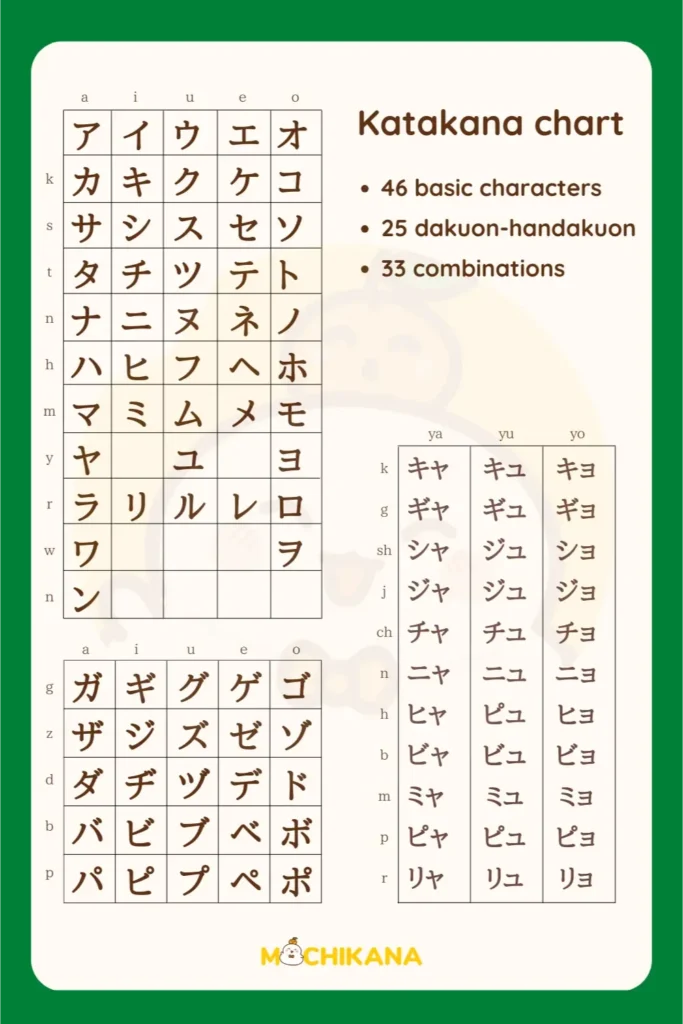
Dakuten & Handakuten (Modified Sounds)
Adding 〃 (dakuten) or ゜ (handakuten) changes the sound:
- ガ (ga), ギ (gi), グ (gu), ゲ (ge), ゴ (go)
- パ (pa), ピ (pi), プ (pu), ペ (pe), ポ (po)
Combined Katakana (Yōon)
Small ャ, ュ, and ョ create combined sounds:
- キャ (kya), シュ (shu), チョ (cho)
How to Write Katakana Correctly
Katakana has sharp, straight strokes compared to hiragana. Follow these tips:
- Stroke Order Matters—Always follow the correct sequence.
- Balance the Angles—Keep lines clean and angular.
- Practice Grid Sheets—Use printable worksheets for consistency.
5 Tips to Learn Katakana Fast
- Use Flashcards—Apps like Anki or physical cards help with recall.
- Write daily—repetition strengthens memory.
- Learn with loanwords—practice with words like ピザ (“piza—”pizza”).
- Katakana Drills—Online quizzes (e.g., Tofugu’s Katakana Quiz).
- Mnemonic Tricks—Associate shapes with objects (e.g., ニ (ni) looks like knees).
Common Katakana Words to Practice
- Food: ハンバーガー (“hanbaagaa—”hamburger”)
- Tech: コンピューター (konpyuutaa – “computer”)
- Countries: アメリカ (Amerika – “America”)
Final Thoughts
Mastering katakana is a crucial step in learning Japanese. With consistent practice, you’ll quickly recognize and read foreign words in Japanese texts.
Ready to test your Katakana skills? Try writing these words:
- テレビ (terebi – “TV”)
- アイスクリーム (aisukurīmu—”ice “cream”)
Start practicing today, and soon, Katakana will become second nature!
The Role of Katakana in Japanese
So, what makes Katakana special? It plays a unique and important role in the Japanese writing system. Primarily, Katakana is used for writing foreign words and names, known as loanwords or “gairaigo.” For example, the English word “television” becomes テレビ (terebi) in Japanese, and “coffee” is written as コーヒー (kōhī). Katakana is also used for onomatopoeia, which are words that imitate sounds. Imagine writing the sound of a dog barking—in Katakana, it’s ワンワン (wanwan).
But that’s not all! Katakana is also the go-to script for scientific and technical terms, especially those derived from foreign languages. Moreover, when you want to emphasize something in writing, katakana is your tool, much like how we use italics in English.
How to Learn Katakana
Learning Katakana is similar to learning Hiragana:
- Make sure you’ve gone through Hiragana. It’s much easier to progress in this writing system after finishing Hiragana. So make sure to master the first writing system before moving on to Katakana.
- Practice Writing: Start with each character and follow the correct stroke order. This helps you remember their shapes and improves your handwriting.
- Read and Recognize: Practice reading Katakana words, especially those that are familiar in English. Reading menus, ads, or even loanwords helps reinforce your skills.
- Practice Pronunciation: Katakana pronunciation is straightforward, with each character representing a single sound. Practice saying the words out loud for better memory.
Katakana Mnemonics: Easy Memory Tricks to Master Japanese Characters
Katakana can be tricky at first, especially because some characters look similar (e.g., シ (shi) vs. ツ (tsu)). Mnemonics (memory aids) help by linking each character to a familiar image or word, making recall faster and more fun.
Best Katakana Mnemonics (Full Chart)
Vowels (A, I, U, E, O)
| Katakana | Mnemonic |
|---|---|
| ア (A) | An “A”ngel flying with pointy wings. |
| イ (I) | “I” (me) standing straight with a hat. |
| ウ (U) | “U” (you) pointing up with a bent arm. |
| エ (E) | An “E”levator with three floors. |
| オ (O) | An “O”lympic medal hanging on a ribbon. |
K-Column (Ka, Ki, Ku, Ke, Ko)
| Katakana | Mnemonic |
|---|---|
| カ (Ka) | A “Ka”ngaroo kicking forward. |
| キ (Ki) | A “Key” with a straight edge. |
| ク (Ku) | A “Coo”king pot with a bent handle. |
| ケ (Ke) | A “Ke”ndama toy with a diagonal stick. |
| コ (Ko) | A “Co”ffin shaped like a square. |
T-Column (Ta, Chi, Tsu, Te, To)
| Katakana | Mnemonic |
|---|---|
| タ (Ta) | A “Ta”ckle in football (looks like a player diving). |
| チ (Chi) | A “Chee”se wedge with a bite taken out. |
| ツ (Tsu) | A “Tsu”nami wave crashing down (three drops). |
| テ (Te) | A “Te”nnis racket hitting a ball. |
| ト (To) | A “To”tem pole with a small mark. |
Confusing Pairs—How to Tell Them Apart
Some Katakana look almost identical. Here’s how to remember them:
🔹 シ (shi) vs. ツ (tsu)
- シ (shi) → “She” has a smiling face (dots are horizontal).
- ツ (tsu) → “Tsu”nami waves fall vertically (dots are vertical).
🔹 ソ (so) vs. ン (n)
- ソ (so) → “So” lar rays slanting down.
- ン (n) → “N” is a quick scribble, like a short hum.
How to Use Mnemonics Effectively
- Visualize the Image—When you see ケ (ke), imagine a kendama toy.
- Say It Out Loud—Combine the sound with the mnemonic (e.g., “Koffin = コ”).
- Draw & Associate—Sketch the character while thinking of the image.
- Quiz Yourself—Cover the Katakana and recall based on the mnemonic.
Bonus: Katakana Mnemonics Flashcards
For extra practice, create flashcards with:
- Front: Katakana character
- Back: Mnemonic + example word (e.g., ピザ “pizza”)
Or use apps like
- Anki (customizable flashcards)
- Tofugu’s Katakana Quiz (interactive learning)
Conclusion
Learning katakana is a vital step in mastering Japanese. It unlocks the ability to read foreign words, navigate daily life in Japan, and build a strong foundation for further language learning. With dedication and the tips provided in this guide, you’ll be reading and writing katakana in no time. Start your journey today!
🧠 Katakana Quiz – Level: Beginner
Choose the correct Romaji (English reading) for each Katakana word.
1. カメラ
A) Kamira
B) Kamera
C) Kamela
D) Kamura
2. アイスクリーム
A) Ice Cream
B) Aisu Cream
C) Aisu Kurimu
D) Aiso Cream
3. テレビ
A) Televi
B) Terebi
C) Telubi
D) Terabi
4. スポーツ
A) Supotsu
B) Supōtsu
C) Sportsu
D) Supaatsu
5. コンピューター
A) Konpyuuta
B) Konbyutaa
C) Konpyuutaa
D) Kompyuuta
6. メニュー
A) Menu
B) Menyuu
C) Menyu
D) Menyua
7. バナナ
A) Banana
B) Banara
C) Bananana
D) Banaya
8. ホテル
A) Hoteru
B) Hoteru
C) Hoter
D) Hotele
Answer Key:
- B (Kamera)
- C (Aisu Kurimu)
- B (Terebi)
- B (Supōtsu)
- C (Konpyuutaa)
- B (Menyuu)
- A (Banana)
- A (Hoteru)
FAQs
How long does it take to learn katakana?
With consistent practice, you can learn katakana in 1–2 weeks.
What is the best way to memorize katakana characters?
Use mnemonics, flashcards, and repetitive writing for effective memorization.
Can I learn katakana before hiragana?
Yes, but learning hiragana first is recommended, as it’s used more frequently in Japanese.
Are there any good apps for learning katakana?
Apps like Duolingo, Anki, and Kana Quiz are excellent for katakana practice.
Why is katakana used for foreign words?
Katakana simplifies the pronunciation of foreign words, adapting them to the Japanese sound system.