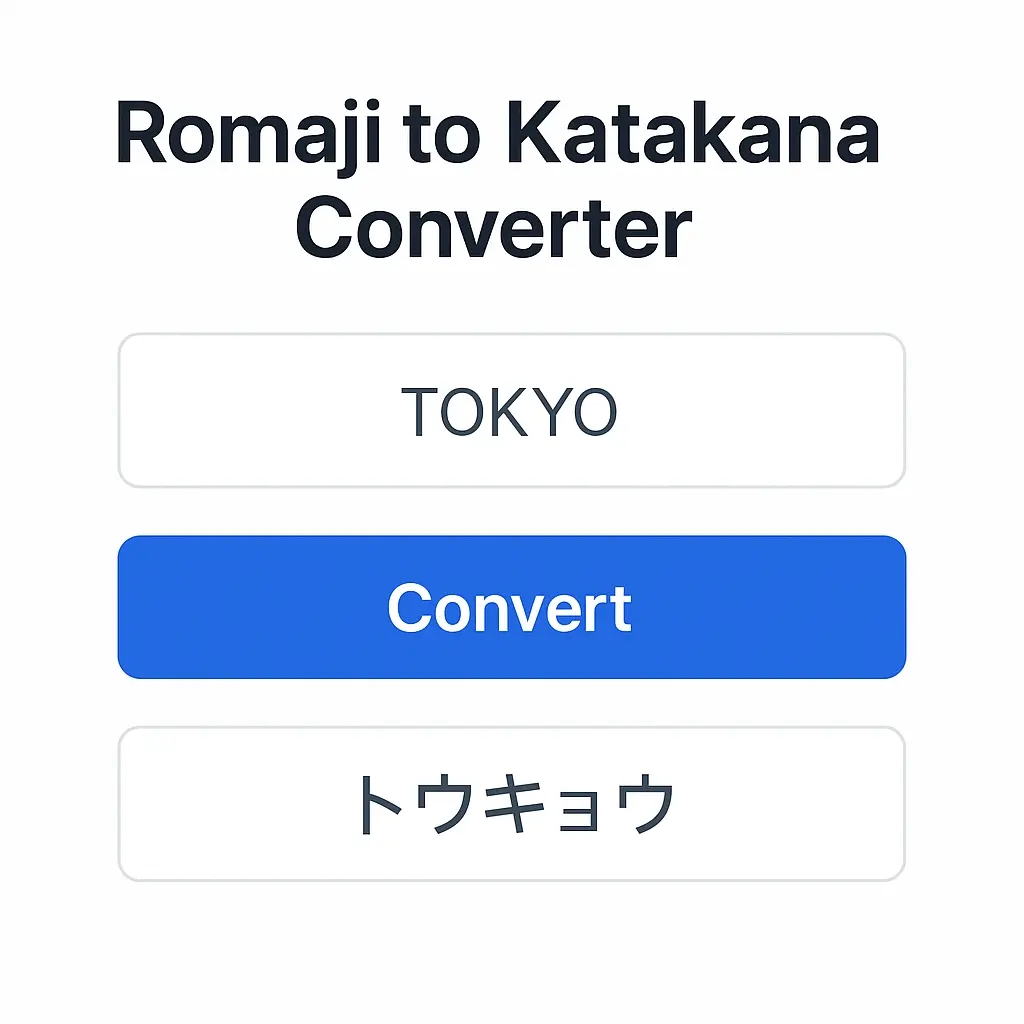
If you’re learning Japanese or working with the language, converting Romaji to Katakana is an essential skill.
Romaji to Katakana Converter
Master Japanese Character Conversion in Seconds
Convert Romaji to Katakana instantly with our free, advanced online converter tool
Advanced Romaji to Katakana Converter
What is Romaji to Katakana Conversion?
Romaji (ローマ字) is the Romanized representation of Japanese sounds using Latin characters. It serves as a bridge for learners transitioning from English to Japanese writing systems. Understanding how Romaji converts to Katakana is fundamental for anyone studying Japanese.
• “Konnichiwa” → 「コンニチワ」 (Hello)
• “Arigatou” → 「アリガトウ」 (Thank you)
• “Sakura” → 「サクラ」 (Cherry blossom)
• “Sushi” → 「スシ」 (Sushi)
Understanding Katakana
Katakana (カタカナ) is one of Japan’s three writing systems, alongside Hiragana and Kanji. It serves specific purposes in Japanese:
- Foreign Names: 「マイケル」for “Michael”, 「ジョン」for “John”
- Loanwords: 「コーヒー」for “coffee”, 「インターネット」for “internet”
- Scientific & Technical Terms: 「ビタミン」for “vitamin”, 「キログラム」for “kilogram”
- Onomatopoeia & Sound Effects: Used in manga and anime
- Emphasis & Stylization: Sometimes used for emphasis in writing
Mastering Katakana conversion is essential for reading modern Japanese texts, especially technical documents and international business communications.
How to Convert Romaji to Katakana: Three Proven Methods
Method 1: Use an Online Romaji to Katakana Converter (Fastest & Easiest)
For quick, accurate, and hassle-free conversion, using an online Romaji to Katakana converter like ours is the most efficient approach. This method is ideal for:
Method 2: Use a Japanese IME Keyboard (Direct Input)
Most modern devices support switching to a Japanese keyboard input method. This method works great once you’re comfortable with Romaji typing:
- Windows: Enable “Japanese IME” in Settings → Language → Add Japanese input method
- Mac: System Preferences → Keyboard → Input Sources → Add “Japanese” (Romaji)
- iOS: Settings → General → Keyboard → Add Japanese keyboard option
- Android: Settings → Languages and input → Add Japanese keyboard
How it works: Type Romaji (e.g., “sakura”), and the keyboard will automatically convert it to Katakana 「サクラ」 or Hiragana 「さくら」 based on your selection.
Method 3: Learn the Katakana Chart (Long-Term Mastery)
For true mastery, memorizing the Katakana alphabet is invaluable. This foundational knowledge helps with manual conversion and faster reading comprehension.
| Romaji | Katakana | Pronunciation | Example |
|---|---|---|---|
| a | ア | ah | アリ (ant) |
| ka | カ | kah | カメ (turtle) |
| sa | サ | sah | サケ (sake) |
| tsu | ツ | tsoo | ツル (crane) |
| n | ン | ng | テン (point) |
| chi | チ | chee | チケット (ticket) |
| shi | シ | shee | シマ (island) |
Why Use a Romaji to Katakana Converter?
Common Tricky Romaji to Katakana Conversions
Japanese has several Romaji combinations that confuse learners. Here are the most common pitfalls:
• “shi” vs “si”: Both theoretically represent the same sound (シ), but “shi” is the standard Hepburn romanization
• “chi” vs “ti”: “chi” (チ) is correct; “ti” is outdated
• “tsu” vs “tu”: “tsu” (ツ) is the proper romanization; “tu” is incorrect
• “fu” vs “hu”: “fu” (フ) is standard; “hu” is rarely used
• “n” vs “nn”: Both can represent ン, but context matters for proper placement
• Double consonants: “kka” becomes ッカ (small tsu + ka), not カカ
Pro Tips for Accurate Conversion
- Always use Hepburn romanization for consistency (the most common standard)
- Pay attention to long vowels marked with macrons (ō, ū, ē)
- Double consonants indicate a small っ (tsu) before the next syllable
- The letter “n” at the end of a word usually becomes ン (n sound)
- When in doubt, listen to native Japanese pronunciation to verify
Frequently Asked Questions (FAQ)
A: Both represent the same sounds, but serve different purposes. Hiragana is used for native Japanese words and grammar, while Katakana is used for foreign loanwords, names, and emphasis. Think of them as different fonts for the same alphabet.
A: This converter specifically converts Romaji to Katakana. Kanji conversion (Romaji → Kanji) is a more complex process that requires context and dictionary lookup, which is beyond this tool’s scope.
A: Romaji is excellent for beginners, but it’s important to transition to Hiragana and Katakana as soon as possible. Most Japanese texts don’t use Romaji, so learning native writing systems is essential for real fluency.
A: Hepburn is the most widely used in English-speaking countries and is ideal for learners. Kunrei and Nihon-shiki are more systematic but less commonly used internationally.
A: Yes! English loanwords in Japanese are typically written in Katakana. For example, “computer” becomes 「コンピューター」. This tool can help you convert English words as if they were Romaji.
A: Our converter uses a comprehensive Romaji-Katakana mapping table covering all basic sounds, contracted sounds (youon), and special characters. It handles edge cases like double consonants and long vowels accurately.
Conclusion: Master Romaji to Katakana Conversion Today
Converting Romaji to Katakana is an essential skill for anyone serious about learning Japanese. Whether you’re a student, translator, business professional, or anime enthusiast, mastering this conversion will significantly improve your Japanese writing and reading abilities.
You now have three proven methods at your disposal:
- ✅ Online Converter: The fastest option for instant, accurate conversions
- ✅ Japanese IME Keyboard: The most practical for daily use once you’re comfortable with Romaji input
- ✅ Manual Learning: The most thorough approach for long-term mastery
Start converting today using our free Romaji to Katakana converter above. It requires no registration, works on all devices, and provides instant results. As you practice and become more familiar with Katakana patterns, you’ll naturally internalize these conversions and be able to recognize them in any Japanese text you encounter.
Happy learning! がんばってください (Ganba tte kudasai – Good luck!)