Are you having trouble recalling the essential vocabulary from Minna no Nihongo Lesson 30? This comprehensive guide breaks down every word with kanji, romaji, English translations, real-life examples, and expert memorization techniques—plus a free quiz to test your knowledge! Perfect for JLPT N5/N4 learners. Explore the Minna no Nihongo Lesson 30 Vocabulary to enhance your Japanese language skills.
Why This Lesson 30 Vocabulary Guide is Different
Most vocabulary lists just throw words at you. This guide actually helps you remember them by:
✅ Providing real-life example sentences (so you see words in context)
✅ Highlighting common mistakes (like confusing 貸す vs. 借りる)
✅ Including memory tricks & quizzes (for active learning)
✅ Optimizing for JLPT N5 success (covers all test-relevant terms)
Bonus: Free downloadable PDF checklist at the end!
Minna no Nihongo Lesson 30 Vocabulary: Essential Words for Mastery
Need More Minna no Nihongo Help?: Lesson 31 Vocabulary.
| はります | put up, post, paste |
| 掛けます [かけます] | hang, Over you |
| 飾ります [かざります] | decorate, display |
| 並べます [ならべます] | arrange, line up |
| 植えます [うえます] | to plant, to grow |
| 戻します [もどします] | return, put ~ back |
| まとめます [まとめます] | put ~ together, put ~ in shape, sum up |
| 片付けます [かたづけます] | put things in order, tidy up |
| しまいます | put things in their proper place |
| 決めます [きめます] | decide |
| 知らせます [しらせます] | to inform |
| 相談します [そうだんします] | consult, discuss |
| 予習します [よしゅうします] | prepare one’s lesson |
| 復習します [ふくしゅうします] | review one’s lesson |
| そのままにします [そのままにします] | leave thing as they are |
| お子さん [おこさん] | (someone else’s) child |
| 授業 [じゅぎょう] | class |
| 講義 [こうぎ] | lecture |
| ミーティング | meeting |
| 予定 [よてい] | a plan, a scheduled |
| お知らせ [おしらせ] | a notice |
| 案内書 [あんないしょ] | guidebook |
| カレンダー | calendar |
| ポスター | poster |
| ごみ箱 [ごみばこ] | trash can, dustbin |
| 人形 [にんぎょう] | doll |
| 花瓶 [かびん] | vase |
| 鏡 [かがみ] | mirror |
| 引き出し [ひきだし] | drawer |
| 玄関 [げんかん] | front door, porch, entrance hall |
| 廊下 [ろうか] | corridor, hallway |
| 壁 [かべ] | wall |
| 池 [いけ] | pond |
| 交番 [こうばん] | police box |
| 元の所 [もとのところ] | original place |
| 周り [まわり] | round, around |
| 真ん中 [まんなか] | center |
| 隅 [すみ] | corner |
| まだ | not yet |
| ~ほど | about |
| 予定表 [よていひょう] | schedule |
| ご苦労さま [ごくろうさま] | Thank you for your hard work |
| 希望 [きぼう] | hope, request |
| 何かご希望がありますか [なにかごきぼうがありますか] | Do you have any requests? |
| これはいいですね。 | musical |
| ブロードウェイ | That’s a good idea, that sounds nice |
| ブロードウエイ | That’s a good idea; that sounds nice |
| 丸い [まるい] | round |
| 月 [つき] | moon |
| ある~ | one ~, a certain |
| 地球 [ちきゅう] | earth |
| うれしい | happy, glad |
| 嫌 [いや] | hateful, disagreeable |
| すると [すると] | and then |
| 目が覚めます [めがさめます] | wake up |
Lesson 30 Vocabulary List (With Kanji, Romaji & Examples)
🔹 Must-Know Verbs
These action words are essential for daily conversations in Japanese.
| Japanese | English | Example Sentence |
|---|---|---|
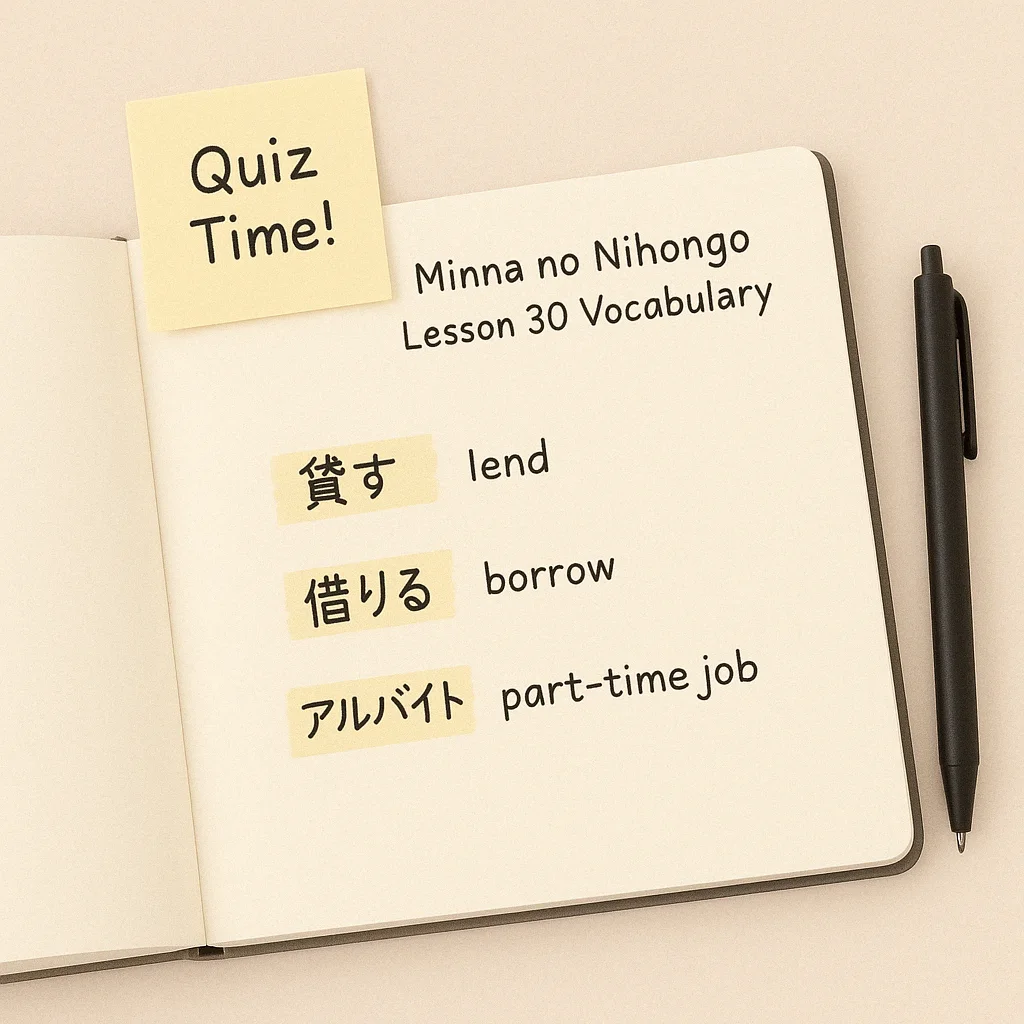
| かす | to lend | ペンを貸してください。 (Please lend me a pen.) |
| かりる | to borrow | ペンを貸してください。 (Please lend me a pen.) |
| 借りる | to help | 図書館で本を借りました。 (I borrowed a book from the library.) |
💡 Pro Tip: The pair 貸す (lend) vs. 借りる (borrow) often confuses learners. Think:
- 貸す (kasu) → “ka-ching!” (you’re lending money)
- 借りる (kariru) → “car I borrow“
🔹 Essential Nouns for Daily Life
These words appear frequently in conversations and the JLPT N5.
| Japanese | Romaji | English |
|---|---|---|
| アルバイト | arubaito | part-time job |
| じゅぎょう | jugyou | class/lesson |
| やすみ | yasumi | break/day off |
Read More: Minna No Nihongo Lesson 29 Vocabulary
🗣️ Sample Dialogue:
A: アルバイトはどこですか? (Where is your part-time job?)
B: レストランで働いています。 (I work at a restaurant.)
🎯 How to Memorize These Words Faster (Proven Methods)
1. Flashcards (Spaced Repetition)
- Use Anki or physical flashcards.
- Put the Japanese word on one side and the example sentence on the back.
2. Mnemonics & Memory Tricks
- アルバイト (arubaito) → “I work a bit (baito) at the aluminum factory” (silly, but memorable!)
- 授業 (jugyou) → “Ju-gyou” sounds like “Jewels go” to class.
3. Shadowing Technique
- Listen to native speakers (YouTube, podcasts) and repeat aloud to improve pronunciation.
⚠️ Common Mistakes to Avoid
❌ Mixing up 貸す (lend) and 借りる (borrow)
- Correct: 友達に本を貸した (I lent a book to my friend.)
- Wrong: 友達に本を借りた (This means YOU borrowed!)
❌ Forgetting Polite Speech
- Always use ~てください for requests (e.g., 貸してください)
Lesson 30 Vocabulary Quiz
- What does 手伝う mean?
a) To borrow
b) To help
c) To work - Write a sentence using アルバイト.
(Answers: 1=b, 2=Example: 私はコンビニでアルバイトをしています.)
1. Which word means “to lend”?
A) 借りる (kariru)
B) 貸す (kasu)
C) 手伝う (tetsudau)
2. How do you say “part-time job” in Japanese?
A) 授業 (jugyou)
B) アルバイト (arubaito)
C) 休み (yasumi)
3. Choose the correct sentence using 手伝う (to help):
A) 本を貸してください。 (Please lend me a book.)
B) 母に料理を手伝います。 (I help my mom cook.)
C) アルバイトを探しています。 (I’m looking for a part-time job.)
4. What’s the English meaning of 授業 (jugyou)?
A) Break
B) Class/lesson
C) Borrow
5. What is a common mistake with 貸す and 借りる?
A) Using 貸す when you mean “to borrow”
B) Forgetting the kanji
C) Pronouncing them the same way
🎯 Answers:
- B) 貸す (kasu)
- B) アルバイト (arubaito)
- B) 母に料理を手伝います。
- B) Class/lesson
- A) Using 貸す when you mean “to borrow”
🚀 What to Study Next
- Lesson 30 Grammar Guide (Coming Soon!)
- JLPT N5 Full Vocabulary List
- Japanese Sentence Patterns for Beginners
🔗 Download: Free Lesson 30 Vocabulary PDF
💬 Final Tips for Success
- Review daily (10 minutes > 1 hour weekly)
- Join our Discord for speaking practice
- Watch Japanese dramas to hear these words in action
🎯 Conclusion: Master Lesson 30 Vocabulary & Keep Improving!
You’ve just taken a big step toward fluency by learning Minna no Nihongo Lesson 30 vocabulary—the essential words for daily conversations, work, and the JLPT N5😊.