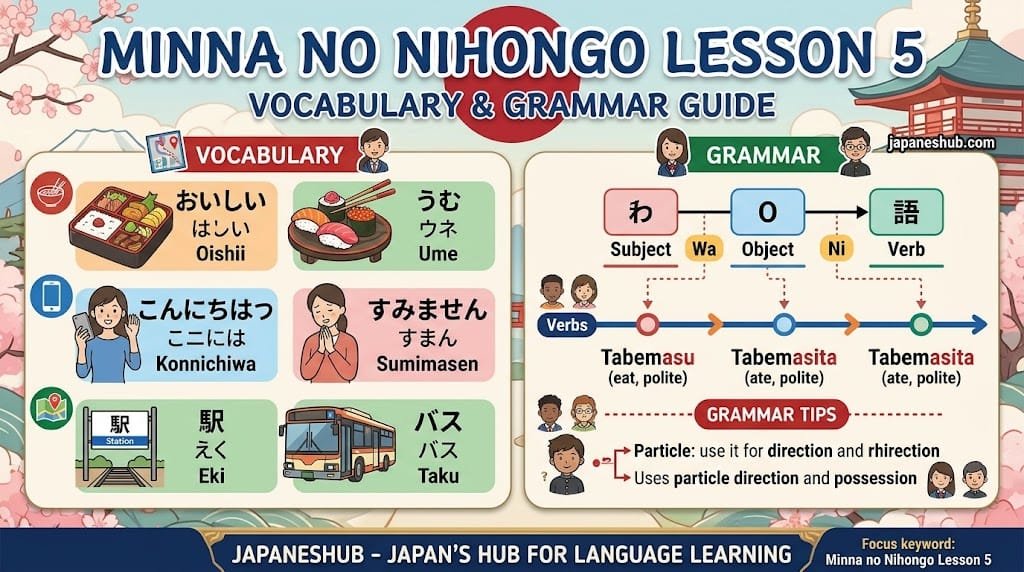
Struggling to understand and use Japanese vocabulary and grammar in everyday conversations? Do you get tangled up in verb conjugations and sentence structures? You’re not alone! Learning a new language can be overwhelming, especially when it comes to the nuances of Japanese grammar.
In our Minna no Nihongo series, we’ve been breaking down the basics of Japanese language lessons, covering essential phrases, vocabulary, and grammar rules. In this fifth installment, we’ll dive deeper into Japanese vocabulary and grammar, focusing on sentence structures and verb conjugation. Our goal is to empower you with the tools you need to communicate confidently in Japanese.
In this article, we’ll explore the following topics:
- Essential vocabulary for common situations
- Grammar rules for sentence structure and verb conjugation
- Tips for practicing and improving your Japanese language skills
Whether you’re a beginner or intermediate learner, this guide is designed to help you improve your Japanese language skills and become more proficient in everyday conversations. So, let’s get started!
Also Read:
- For Japanese writing systems or scripts: Mention how Kanji and Kana form the foundation and link to Learn Katakana: The Ultimate Guide for Beginners 2025.
- For Japanese typing or input methods: Reference how to practice typing characters using a Japanese Hiragana Keyboard 2025.
- For converting romaji or script forms: Link to the Romaji to Katakana Converter 2025 when discussing pronunciation or script conversion.
- For mastering verb conjugations: Connect the grammar section on verb forms to the Japanese Te Form 2025 guide.
- For listening comprehension practice: Suggest extra audio practice using the Minna no Nihongo N5 Listening: Free Practice Audio Tips post.
Introduction to Japanese Language Lessons
Welcome to Minna no Nihongo, Japan’s Hub for Language Learning! In this series of lessons, we will guide you through the intricacies of the Japanese language, helping you to become proficient in no time. In this fifth lesson, we will focus on vocabulary and grammar, which are essential components of Japanese language skills.
Japanese language lessons are designed to be engaging, interactive, and easy to follow. Our approach is tailored to suit learners of all levels, from beginners to advanced students. We believe that learning a language should be a fun and rewarding experience, and our lessons are crafted to reflect this.
In Japanese language lessons, vocabulary and grammar are often intertwined. Understanding the correct usage of vocabulary requires a grasp of grammar, and vice versa. In this lesson, we will cover essential vocabulary and grammar points that will help you to communicate effectively in Japanese.
We will start with some essential vocabulary, including basic phrases, food words, and common expressions. These words and phrases will help you to navigate everyday situations, such as ordering food at a restaurant or introducing yourself to someone new.
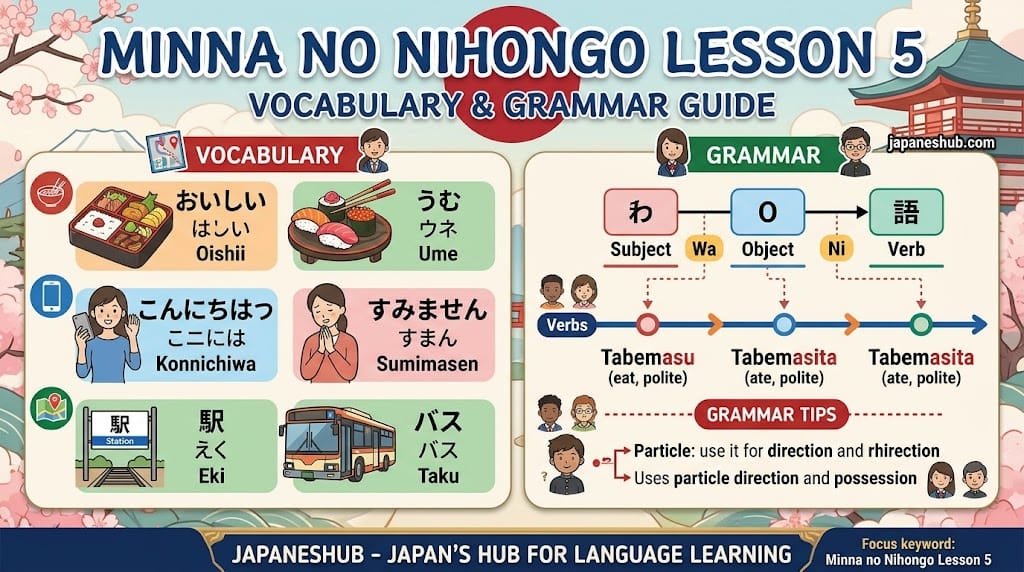
Next, we will delve into grammar, focusing on sentence structures and verb conjugation. Japanese grammar can be complex, but with practice and patience, you can master it. We will cover the basics of sentence structure, including subject-verb-object word order, and explore the different forms of verb conjugation, including present, past, and future tenses.
Throughout this lesson, we will provide practical examples and exercises to help you to practice and reinforce your learning. Our goal is to make learning Japanese an enjoyable and interactive experience, and we are excited to have you join us on this journey.
Japanese Vocabulary: Essential Words & Phrases
In this section, we will cover essential words and phrases that are crucial for everyday communication in Japanese. Mastering these vocabulary items will help you express your thoughts and needs clearly, making your interactions more efficient and effective.
Basic Phrases
- Konnichiwa (hello) – Informal greeting
- Ohayou gozaimasu (good morning) – Formal greeting
- Konbanwa(good evening) – Formal greeting
- Sayounara (goodbye) – Formal way to say goodbye
- Arigatou (thank you) – Express gratitude
- Sumimasen (excuse me/Sorry) – Apologize or get attention
Food and Drink
- Mata ne (let’s eat) – Invite someone to eat
- Oishii (delicious) – Describe food as tasty
- Ume (plum) – Common fruit
- Mugicha (roasted barley tea) – Traditional Japanese tea
Directions and Transportation
- Machi (street) – General term for a street
- Dōri (road) – Term for a road or street
- Eki (station) – Train station
- Taku (bus) – Public transportation
Shopping and Payment
- O-Genki desu ka? (How are you?) – Greet a shopkeeper
- Yōga desu (okay) – Respond to a question
- Omedetō gozaimasu (congratulations) – Respond to a gift
- Kaisha (store) – General term for a shop
Useful Words
- Hai (yes) – Respond to a question
- Iie (no) – Respond to a question
- Mada(not yet) – Express that something has not happened
- Mata (again) – Reiterate a request
By learning and practicing these essential words and phrases, you’ll be able to communicate effectively in everyday situations, making your interactions with the Japanese culture more enjoyable and enriching.
Grammar Guide: Understanding Japanese Sentence Structure
Japanese sentence structure is distinct from that of European languages, with a subject-object-verb word order. However, the language also employs various grammatical particles to convey meaning and indicate relationships between words.
Basic Sentence Structure
A basic Japanese sentence consists of three main components: the subject (, wa), the object (, o), and the verb (, ni). For example:
- (Watashi wa shokuji o tabemasu) – I am eating rice.
- (Anata wa gakko ni ikimasu) – You are going to school.
Polite and Impolite Verbs
Japanese verbs have two forms: polite (, keigo) and impolite (, tatemae). The polite form is used when speaking to someone older or in a formal setting, while the impolite form is used in casual conversations.
- (Watashi wa shokuji o taberu) – I am eating rice (impolite)
- (Watashi wa shokuji o tabemasu) – I am eating rice (polite)
Verb Conjugation
Japanese verbs are conjugated based on the subject’s person and number. For example:
- (Watashi wa taberu) – I eat –
- (Anata wa taberu) – You eat
- (Kare wa taberu) – He eats
- (Boku wa taberu) – I eat (informal)
- (Kare wa taberu) – He eats (informal)
Useful Grammar Tips
- Use the verb (de) to indicate direction or movement: (Watashi wa Tokyo e ikimasu) – I am going to Tokyo.
- Use the verb (ni) to indicate purpose or intention: (Watashi wa gakko ni ikimasu) – I am going to school.
- Use the grammatical particle (no) to indicate possession: (Watashi no phone ga doko ni arimasu ka) – Where is my phone?
Japanese Verb Conjugation: Present, Past, & Future Tenses
Japanese verb conjugation is a crucial aspect of mastering the language. Understanding the present, past, and future tenses will enable you to express yourself accurately and effectively in various situations.
Present Tense
The present tense in Japanese is used to describe current or habitual actions. The present tense is formed by adding specific suffixes to the verb stem.
- –masu (masu) is used for the present tense of formal or polite language.
- -ru (ru) is used for the present tense of informal or casual language.
- -iru (iru) is used for the present tense of the verb “to be” (e.g., “Watashi wa otsukaresimasu” – “I am working”).
Example:
- Watashi wa tabemasu (I eat)
- Kare wa tabemasu (He/She/It eats)
- Watashi wa taberimashita (I ate)
Past Tense
The past tense in Japanese is used to describe completed actions.
- –ta (ta) is used for the past tense of formal or polite language.
- –tta (ttā) is used for the past tense of informal or casual language.
- –dta (dta) is used for the past tense of the verb “to be” (e.g., “Watashi wa otsukaresimashita” – “I was working”).
Example:
- Watashi wa tabemasita (I ate)
- Kare wa tabemasita (He/She/It ate)
- Watashi wa otsukaresimashita (I was working)
Future Tense
The future tense in Japanese is used to describe actions that will take place in the future.
- –mu (mu) is used for the future tense.
- –ya (ya) is used for the future tense of the verb “to be” (e.g., “Watashi wa otsukarimasu” – “I will be working”).
Example:
- Kare wa tabemasu (かれ は たべます。) ーー(He/She/It will eat)
- Watashi wa otsukarimashita(わたし は つかれました。) ーー(I will be working)
- Watashi wa tabemasu (わたし は たべます。) — (I will eat)
Japanese Pronunciation: Tips for Accurate Pronunciation
Proper pronunciation is essential for effective communication in Japanese. Mastering the correct sounds and intonation will help you express yourself confidently and accurately. Here are some tips to improve your Japanese pronunciation:
Pay Attention to Vowel Sounds
In Japanese, vowel sounds can change significantly depending on the context. For example, the vowel sound in “ka” changes to “kaa” when it appears before the consonant “n”. Similarly, the vowel sound in “ki” changes to “ki-uu” when it appears before the consonant “i”.
To practice this, listen to native speakers and try to mimic the correct vowel sounds. You can also practice with online resources, such as language learning apps or YouTube videos.
Master the Different Tones
Japanese has a complex system of tones, which can significantly change the meaning of words. For example, the word “kya” (cry) has a different meaning when pronounced with a rising tone (kyaaa) compared to a falling tone (kyaa).
To master the different tones, practice with a native speaker or listen to recordings of Japanese songs or TV shows. You can also use online resources, such as language learning apps or YouTube videos, that provide tone practice exercises.
Focus on the Correct Stress Patterns
Stress patterns in Japanese can be challenging to master, but it’s essential for proper pronunciation. For example, the word “sumimasen” (excuse me) has a different stress pattern than “sumimasen” (I’m sorry).
To practice the correct stress patterns, listen to native speakers and try to mimic the correct intonation. You can also practice with online resources, such as language learning apps or YouTube videos.
Practice with Native Speakers
One of the best ways to improve your Japanese pronunciation is to practice with native speakers. You can find language exchange partners online or in person, or attend language exchange events in your area.
Remember to be patient and persistent when practicing your pronunciation. With consistent practice and exposure to native speakers, you’ll be able to improve your Japanese pronunciation over time.
Common Japanese Expressions and Idioms
In Japanese culture, idioms and expressions are an essential part of the language, adding flavor and nuance to everyday conversations. Mastering these expressions can help you sound more natural and fluent in Japanese. Here are some common Japanese expressions and idioms, along with their meanings and practical examples:
- “Yume o miru”(pronounced: yoo-may oh mee-roo) – “To see a dream” or “To be on the right track”
Meaning: This expression means that something is going well or that you’re on the right path. Example: “Watashi wa gakko ni ikimasu” (I’m going to school) – “Yume o miru” (I’m on the right track)
- “Muzukashii desu” (pronounced: moo-zoo-kah-see-ee desu) – “It’s difficult”
Meaning: This expression is used to convey that something is challenging or hard. Example: “Kodomo no oen no koto wa muzukashii desu” (Playing with kids is difficult)
- “Sumimasen” (pronounced: soo-mee-mah-sen) – “Excuse me” or “Sorry”
Meaning: This expression is used to apologize or get someone’s attention. Example: “Sumimasen, o-genki desu ka?” (Excuse me, are you okay?)
- “Dōitsuka” (pronounced: doh-ee-tsoo-kah) – “How much?”
Meaning: This expression is used to ask for the price or cost of something. Example: “Dōitsuka?” (How much?)
- “Arigatou gozaimasu”(pronounced: ah-ree-gah-toh goh-zah-ee-moss) – “Thank you very much”
Meaning: This expression is used to express gratitude or appreciation. Example: “Arigatou gozaimasu, o-genki desu” (Thank you very much, I’m fine)
These expressions and idioms are commonly used in everyday conversations in Japan. By incorporating them into your vocabulary, you’ll be able to communicate more effectively and naturally with native speakers.
Japanese Writing Systems: Kanji, Hiragana, and Katakana
Learning the Japanese writing systems is an essential part of mastering the Japanese language. Japan has a unique writing system that consists of three main components: Kanji, Hiragana, and Katakana.
Kanji
Kanji, also known as Chinese characters, are logograms that originated from China and were introduced to Japan in the 5th century. Kanji characters are used to represent words and are an integral part of the Japanese writing system. There are thousands of Kanji characters in use today, and learning them can be challenging.
In Japan, Kanji characters are often used in conjunction with Hiragana and Katakana to convey meaning. Kanji characters can be read in several ways, including on their own, with Hiragana, and with Katakana. Understanding Kanji characters is crucial for reading and writing Japanese texts.
Hiragana
Hiragana is a phonetic script used to write Japanese words and grammatical elements. It is used to represent the sounds of Japanese words and is an essential component of the Japanese writing system. Hiragana is used to indicate the grammatical function of words, such as the subject, object, and verb.
In Japan, Hiragana is used to write native Japanese words, as well as to indicate grammatical relationships. For example, the Hiragana character “wa” is used to indicate the subject of a sentence, while the character “o” is used to indicate the object.
Katakana
Katakana is a phonetic script used to write foreign words, loanwords, and onomatopoeic words. It is used to distinguish between similar-sounding words in Japanese. Katakana is also used to indicate emphasis or stress on a word.
In Japan, Katakana is used to write English loanwords, such as “computer” and “telephone”. It is also used to write onomatopoeic words, such as “kawa” for “water”.
Practical Examples
To illustrate the use of Kanji, Hiragana, and Katakana, let’s consider a simple example:
- “Konnichiwa” (Hello) – This word is written with Hiragana characters “konn” and “iwa”.
- “Kawaii” (Cute) – This word is written with Katakana characters “kawaii”.
- “” (Watashi wa kawaii desu) – This sentence is written with Kanji characters “” (watashi), “” (wa), “” (kawaii), and “” (desu).
In conclusion, Kanji, Hiragana, and Katakana are essential components of the Japanese writing system. Understanding these characters is crucial for reading and writing Japanese texts.
Frequently Asked Questions
Q. What is the Difference between Genki and Irasshaimase?
When it comes to greetings in Japanese, two common phrases often get confused: “genki desu ka?” (lit. “How are you?”) and “irasshaimase” (, lit. “Welcome”). While both phrases are used to greet someone, they have distinct meanings and uses.
“Genki desu ka?” is used to ask about someone’s health or well-being, whereas “irasshaimase” is used to welcome someone to a place, similar to saying “hello” or “welcome.” For example, you might say “irasshaimase” when entering a store or attending a gathering, while “genki desu ka?” would be more suitable in a conversation with a friend or acquaintance.
Q. How do I use the Japanese verb conjugation system?
The Japanese verb conjugation system can be complex, but understanding the basics is essential to communicating effectively. In Japanese, verbs change their endings to indicate tense, aspect, and mood. For example, the verb “iku” (to go) changes to “ikimasu” (to go + polite), “ikatte” (to go + imperative), and “ikimashita” (to go + past tense). The verb conjugation system also includes different verb endings for different tenses, such as the present, past, and future. It’s also worth noting that some verbs have irregular conjugations, so it’s essential to learn these exceptions.
Conclusion
In this fifth lesson of Minna no Nihongo, we’ve covered essential vocabulary and grammar to help you improve your Japanese language skills. By the end of this lesson, you should be able to understand and use key phrases, verb conjugations, and sentence structures to communicate effectively in everyday situations.
To reinforce your learning, we recommend practicing the new vocabulary and grammar in context through conversations, writing, or listening exercises. Try speaking with a language exchange partner or watching Japanese TV shows and movies with English subtitles to apply what you’ve learned. Don’t forget to review the previous lessons to solidify your foundation in the Japanese language.
Next, consider exploring online resources, such as language learning apps or YouTube channels, that offer lessons and exercises tailored to your level of proficiency. With consistent practice and dedication, you’ll become more confident and proficient in speaking, reading, and writing Japanese.