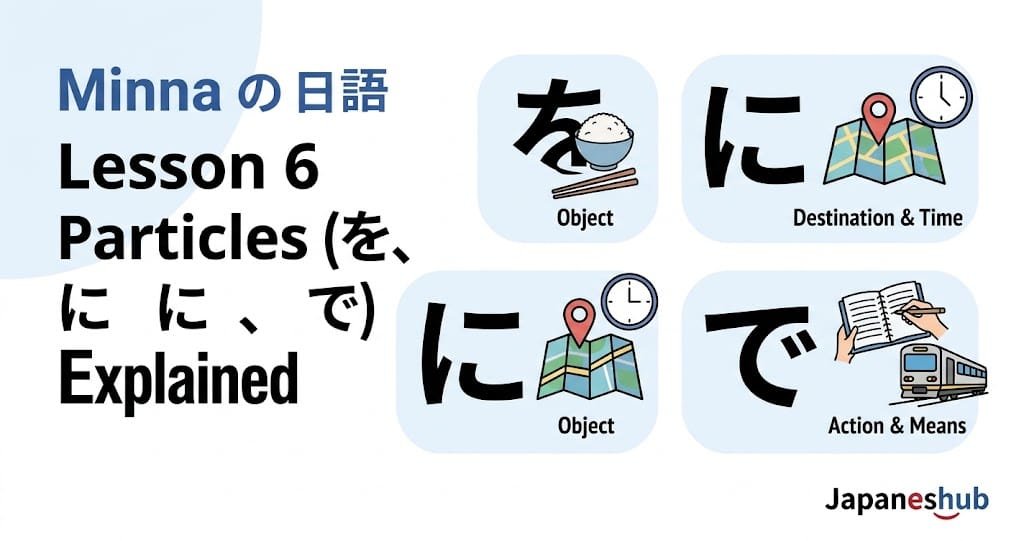
Particles (を、に、で) Explained: Are you struggling to understand the nuances of the Japanese language? One aspect that often trips up learners is the use of particles, which are essential for conveying the correct meaning in a sentence. Particles in Japanese are small words that attach to nouns or pronouns to provide additional information about their function, relationship, or location. Without a grasp of these particles, it’s challenging to express yourself accurately in Japanese.
In this lesson, we’ll delve into the three most commonly used particles in Japanese: (to), (ni), and (de). These particles are fundamental to understanding the structure and grammar of the language. By the end of this lesson, you’ll be able to identify and use these particles correctly in context, helping you to communicate more effectively in Japanese. Whether you’re a beginner or an intermediate learner, this lesson will provide you with the tools and practice exercises needed to master the art of using particles in Japanese.
What are Japanese Particles?
Japanese particles are small words that are used to indicate the relationship between words in a sentence. They help to clarify the meaning of a sentence and are essential for correct grammar in Japanese. There are three main types of particles in Japanese: (o), (ni), and (de).
(o), also known as the “topic particle”, is used to indicate the topic of a sentence. For example:
- Watashi wa hon o yonde imasu. (I am reading a book.)
+ Watashi wa is the topic, and *hon o yonde imasu* is the action being performed on the topic.
- Anata wa kare ga hanasemasen. (You don’t know who he is.)
+ Anata wa is the topic, and kare ga hanasemasen is the action being performed on the topic.
(ni), also known as the “object particle”, is used to indicate the object of a sentence. For example:
- Watashi wa hon o yonde imasu. (I am reading a book.)
+ Hon o yonde imasu is the action being performed, and hon is the object.
- Anata wa kare o shirimasen. (You don’t know who he is.)
+ Kare o shirimasen is the action being performed, and kare is the object.
(de), also known as the “direction particle”, is used to indicate the direction or location of an action. For example:
- Watashi wa Tokyo de ikimasu. (I am going to Tokyo.)
+ Tokyo de ikimasu indicates the action’s direction.
- Anata wa Tokyo ni ikimasen. (You are not going to Tokyo.)
+ Tokyo ni ikimasen indicates the location where the action is not being performed.
In summary, Japanese particles are essential for correct grammar and help clarify a sentence’s meaning. By mastering the use of (o), (ni), and (de), learners can improve their understanding of Japanese and communicate more effectively.
Also Read:
The Three Main Japanese Particles: (を、に、で)
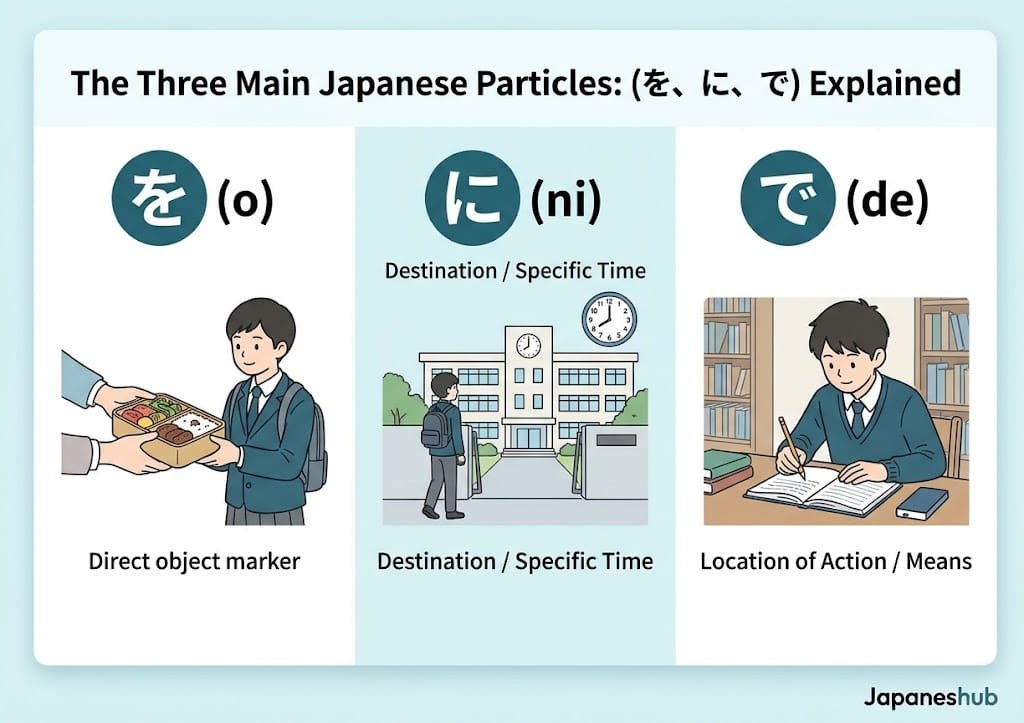
In Japanese grammar, particles play a crucial role in conveying meaning and context. Among the many particles used in Japanese, there are three main particles that are essential to understand: (to), (ni), and (de). These particles are used to indicate the relationship between a subject and an object, location, or action.
(を)
Use を (o) right after the noun that receives the direct action of a verb. For example: Jūsu o nomimasu (I drink juice). Quick check for your readers: Make sure the verb following を is transitive. You cannot use を with intransitive verbs like ikimasu (to go) or kimasu (to come).
- (Watashi wa toki o shita.) – I ate at a certain time. (Here, “toki” is the object of the verb “shita”, meaning “time”.)
- (Anata wa toki o arimasu ka?) – Do you have time? (Here, “toki” is the object of the verb “arimasu”, meaning “to have”.)
(に)
Use に (ni) to show a destination (e.g., Gakkō ni ikimasu – I go to school) or a specific time when an action occurs (e.g., Shichiji ni okimasu – I wake up at 7 o’clock). Emphasize to learners: Think of に as a pin pointing the exact target or arrival point.
- (Watashi wa Tokyo ni ikimashita.) – I went to Tokyo. (Here, “Tokyo” is the location.)
- (Anata wa kono hon o kudasai.) – Give me this book. (Here, “kono hon” is the object of the verb “kudasai”, meaning “to give”, and the recipient is the speaker.)
(で)
Use で (de) to show where an action happens (e.g., Resutoran de tabemasu – I eat at a restaurant). Contrast this with に: if you are just existing or arriving (like imasu or ikimasu), use に. If you are actively doing something there, use で!
- (Watashi wa koto o shita.) – I did something. (Here, “koto” is the object of the verb “shita”, meaning “something”.)
- (Anata wa kono sakazuki o nomimasu ka?) – Are you drinking this sake? (Here, “kono sakazuki” is the instrument of the verb “nomimasu”, meaning “to drink”.)
Practice Exercise:
- Fill in the blanks with the correct particle:
- (Watashi wa _______ o shita.) – I ate at a certain time. (Answer: to)
- (Anata wa _______ o arimasu ka?) – Do you have time? (Answer: to)
- (Watashi wa _______ o ikimashita.) – I went to Tokyo. (Answer: ni)
- (Anata wa kono hon o _______ kudasai.) – Give me this book. (Answer: ni)
- (Watashi wa _______ o shita.) – I did something. (Answer: de)
Using (を) to indicate possession or relationship
In Japanese, the particle (を) is used to indicate possession or relationship between two nouns. It is an essential part of Japanese grammar that helps to clarify the meaning of sentences.
Possessive Relationship
The particle (を) is used to indicate that one noun belongs to or is associated with another noun. For example:
- Anata no gakkiwa (your school) – The particle (no) indicates that the school belongs to the person being addressed.
- Kare no hon (his book) – The particle (no) indicates that the book belongs to the person being referred to.
- Watashi no kimono (my kimono) – The particle (no) indicates that the kimono belongs to the speaker.
Associative Relationship
The particle (を) is also used to indicate an association or connection between two nouns. For example:
- Kare wa gakkiwa o manabeshita (he went to his school) – The particle (wa) indicates a relationship between the person and the school.
- Watashi wa kare to tanoshimi (I am happy with him) – The particle (wa) indicates a relationship between the speaker and the person being referred to.
Practice Exercise
Try to rewrite the following sentences using the particle (を) to indicate possession or relationship:
- Kare wa gakkiwa o manabeshita ka? (Did he go to his school?)
- Watashi wa kare to tanoshimi (I am happy with him)
- Anata no gakkiwa wa doko ni arimasu ka? (Where is your school?)
Using (に) to indicate direction or location
In Japanese, the particle (に) is used to indicate direction or location. It is often used in combination with a verb or a noun to show where something is happening or where something is located.
For example:
Q. I’m going to the store. (o toire ikimasu)
A. Here, (に) is used to indicate the direction of movement (towards the store).
Q. Where is the park? (, doko ni kōen wa arimasu ka)
A. In this sentence, (に) is used to indicate the location of the park.
Another common use of (に) is to indicate the location of a person or object. For example:
Q. My brother is at the park. (, aniki wa kōen ni arimasu)
A. Here, (に) is used to indicate the location of the brother.
Q. This book is on the table. (, kono hon wa o-bako ni aru)
A. In this sentence, (に) is used to indicate the location of the book.
It’s worth noting that (に) can also be used to indicate the location of a person’s body part. For example:
Q. My eye is on the ball. (, myō o bōru ni mi o shite iru)
A. Here, (に) is used to indicate the location of the eye.
To practice using (に) to indicate direction or location, try filling in the blanks with the correct particle:
- I’m going ___________ the store. (, o toire ikimasu)
- Where is the park ___________?
- My brother is ___________ the park. (, aniki wa kōen ni arimasu)
- This book is ___________ the table. (, kono hon wa o-bako ni aru)
By practicing with these examples, you’ll become more comfortable using (に) to indicate direction or location in Japanese.
Using (で) to indicate purpose or condition
In Japanese, the particle (de) is used to indicate purpose, condition, or reason. It is often used in combination with other particles to convey a specific meaning. In this section, we will explore how to use (de) to indicate purpose or condition.
Purpose
The particle (de) is used to indicate the purpose or goal of an action. For example:
- (Gakko ni ikimasu) – I go to school.
- (Gakko de ikimasu) – I go to school for the purpose of studying.
In the second sentence, (de) indicates that the purpose of going to school is to study.
Condition
The particle (de) is also used to indicate a condition or a state. For example:
- (Kare wa nan desu ka) – What is he like?
- (Kare wa kare de iru) – He is like that.
In the second sentence, (de) indicates that the condition of being like someone is being referred to.
Practice Exercise
Try using (de) to indicate purpose or condition in the following sentences:
- (Watashi wa kono ryokou de ikimasu) – I will go on this trip.
- (Kare wa kono ryokou de iru) – He will be on this trip.
Tips and Tricks
- Make sure to use (de) correctly, as it can change the meaning of a sentence.
- Practice using (de) in different contexts to become more comfortable with its usage.
By following these guidelines and practicing regularly, you will become more confident in using (de) to indicate purpose or condition in Japanese.
Common Mistakes to Avoid When Using Japanese Particles
Japanese particles, such as `を` (o), `に` (ni), and `で` (de), are essential components of the Japanese language. However, they can be tricky to use correctly, especially for beginners. In this section, we’ll explore some common mistakes to avoid when using Japanese particles.
Incorrect Use of `を` (o)
One of the most common mistakes is using `を` (o) at the end of a sentence instead of at the beginning. For example, “I like to eat sushi” should be “I like sushi” (, o oishii desu). This is because `を` (o) is used to indicate the object of a verb or a noun, not the subject. If you’re unsure, try replacing `を` (o) with `に` (ni) or `で` (de) to see if it makes sense in the context.
Misusing `に` (ni)
Another mistake is using `に` (ni) as a standalone particle instead of `に` (ni) followed by a noun or verb. For example, “I’m going to the store” should be “I’m going to the store with you” (, o ni arimasu ka). `に` (ni) is used to indicate the location or direction of something, so it’s essential to follow it with a noun or verb.
Forgetting `で` (de)
Some people forget to use `で` (de) when indicating the purpose or reason for something. For example, “I’m going to the store because I need milk” should be “I’m going to the store because I need milk” (, o ni arimasu ka). `で` (de) is used to indicate the purpose or reason for an action, so it’s crucial to include it in your sentence.
By avoiding these common mistakes, you’ll be able to use Japanese particles correctly and improve your overall understanding of the language. Remember to always follow the correct usage of `を` (o), `に` (ni), and `で` (de), and practice makes perfect!
Practice Exercises to Improve Your Nihongo Particle Usage
Now that you have learned the basic particles `wa`, `ga`, and `o`, it’s time to practice using them in different sentences. Try to incorporate the particles `を`, `に`, and `de` into your sentences to improve your Nihongo skills.
Exercise 1: Particle Usage in Sentences
Complete the following sentences with the correct particle:
- (I) like eating sushi. _______________________
- My favorite food is ramen. _______________________
- She is a good friend. _______________________
- The dog is very happy. _______________________
- (I) am going to the store. _______________________
- The book is on the table. _______________________
- He is a good singer. _______________________
- The city is very crowded. _______________________
- (I) have a lot of work to do. _______________________
- The company is expanding. _______________________
- She is a talented artist. _______________________
- The weather is nice today. _______________________
Exercise 2: Particle Usage in Conversations
Imagine you are having a conversation with a friend. Try using the particles `を`, `に`, and `de` in the following scenarios:
- You are asking your friend about their weekend.
- You are complimenting your friend’s new haircut.
- You are apologizing to your friend for something you did.
Use the particles to express your thoughts and feelings naturally. Try to use different particles in each scenario to show your interest, gratitude, or apology.
Exercise 3: Writing Your Own Sentences
Write your own sentences using the particles `を`, `に`, and `de`. Try to use them in different contexts, such as:
- Describing a person’s appearance
- Expressing gratitude
- Apologizing for something
Use the particles to add nuance and depth to your sentences. Remember to use the correct particle for the context and meaning of your sentence.
Frequently Asked Questions
Q. What’s the difference between (を) and (に)?
When learning Japanese, it’s common to get confused between the particles (を) and (に). While both are used to indicate the object of a verb or action, they have distinct meanings and uses.
The particle (を) is used to indicate the object of a verb, action, or a state. For example:
- (Watashi wa ryokou o shite imasu) – I am going on a trip.
- (Kare wa hon o yonde imasu) – He is reading a book.
On the other hand, the particle (に) is used to indicate the location or direction of something. For example:
- (Watashi wa Tokyo ni ikimasu) – I am going to Tokyo.
- (Kare wa hon o yonde imasu) – He is reading the book on the table.
It’s worth noting that (ni) is often used in combination with (de) to indicate the location or direction of an action. For example:
- (Watashi wa Tokyo de ikimasu) – I am going to Tokyo.
By mastering the correct use of (を) and (に), you can improve your Japanese communication skills and express yourself more accurately.
How do I use (で) correctly in a sentence?
To use the particle (で) correctly in a sentence, it is used to indicate the time or period of an action. For example:
- Ogenki desu ka? (How are you?) – Here, (desu) is used to indicate the time or period of the action.
- Tanoshimiitteru desu (I’m having fun) – In this sentence, (desu) is used to indicate the time or period of the action.
(Desu) can also be used in negative sentences to indicate the lack of an action. For example:
- Ogenki ja nai desu (I’m not feeling well) – In this sentence, (ja nai desu) is used to indicate the lack of an action.
It’s worth noting that (desu) is not used in questions or negatives in the present tense, but rather in the present perfect or past tense.
Conclusion
In this lesson of Minna no Nihongo, we’ve explored one of the most essential components of the Japanese language: particles. These tiny words can greatly change the meaning of a sentence, and mastering them is crucial for effective communication in Japanese. By now, you should have a good understanding of the three main particles: `to`, `ni`, and `de`.
To reinforce your learning, practice using these particles in context. Try filling in the blanks with the correct particle in the following sentences:
Q. (Anata wa) (tabemono) o kudasai. (What do you want? / What do you like?)
Answer: (Anata wa) (tabemono) o kudasai `ni` (What do you want? / What do you like?)
Q. (Watashi wa) (tabemono) o tabemasu. (I will eat the food.)
Answer: (Watashi wa) (tabemono) o tabemasu. (I will eat the food.)
Q. (Anata wa) (tabemono) o taberu. (You will eat the food.)
Answer: (Anata wa) (tabemono) o taberu `ni` (You will eat the food.)
By practicing with these exercises, you’ll become more confident in using Nihongo particles correctly. Remember, mastering the particles is just the first step in becoming proficient in Japanese. Keep practicing and exploring the language, and you’ll soon be able to communicate fluently with native speakers.
Don’t forget to check out our next lesson, where we’ll dive into the world of Japanese honorifics. Until then, sayonara!