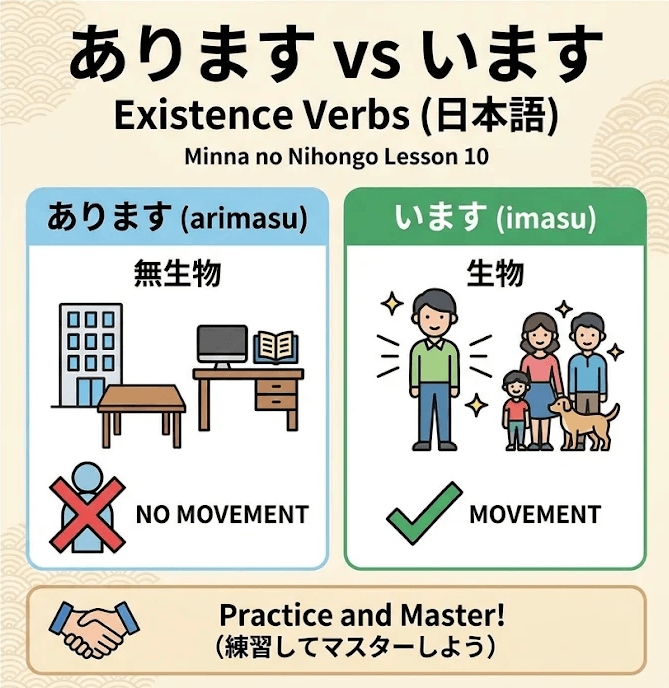
Mastering Nihongo existence vocabulary is essential for anyone trying to understand the nuances of Japanese. Do you find yourself confused between the correct use of あります (arimasu) and います (imasu)? You’re not alone. Many learners of Japanese often get these two verbs mixed up, especially when it comes to expressing existence or presence. In this lesson, we’ll break down the differences between あります and います, and provide you with practical examples and exercises to help you master this essential aspect of Japanese vocabulary
In Japanese, the verb `あります` is used to express existence or presence in the present tense, while `います` is used to express the future tense or a general truth. Understanding the correct use of these two verbs is crucial for effective communication in Japanese, whether you’re speaking, writing, or listening. By the end of this lesson, you’ll be able to use `あります` and `います` with confidence and clarity, taking your Japanese skills to the next level.
Also Read;
- Minna no Nihongo Lesson 9 Vocabulary: Complete Guide & FAQs – Perfect for referencing the previous lesson’s vocabulary.
- Minna no Nihongo Lesson 8 Vocabulary and grammar or な-adjectives vs い-adjectives: Minna no Nihongo Lesson 8 Guide – Great for linking back to lesson 8 concepts.
- Minna no Nihongo Lesson 1 Vocabulary: Ultimate Guide for Beginners – Ideal for early vocabulary foundations.
- 1000 Essential Japanese Words with Meaning (Free PDF & Word Download) – A fantastic resource to link when talking about vocabulary expansion.
- Japanese Hiragana Keyboard 2025 – Useful if you mention typing Japanese characters.
Introduction to Japanese Existence Vocabulary

When it comes to describing existence in Japanese, two main verbs are often confused with each other: `あります` (arimasu) and `います`. While they are used in similar contexts, there is a subtle difference between them.
`あります` (arimasu) is the present tense of the verb `あり` (aru), which means “to exist” or “to be”. This verb is used to describe the existence of a person, place, or thing. For example:
- Watashi wa nan desu ka? (What am I?) – Here, `desu` is the verb `desu` (desu) in the present tense, which means “to exist” or “to be”.
- Kore wa nan desu ka? (What is this?) – Again, `desu` is used to describe the existence of a thing.
On the other hand, `います` (imasu) is the present tense of the verb `います` (imasu), which is a more general verb that means “to be” in a more formal or polite sense. This verb is often used when speaking about a person’s status, occupation, or relationship. For example:
- Watashi wa gakusei desu (I am a student) – Here, `desu` is used to describe the existence of a person’s status.
- Kare wa taku desu (He is a teacher) – Again, `desu` is used to describe the existence of a person’s occupation.
In summary, while both `あります` (arimasu) and `います` (imasu) are used to describe existence in Japanese, `あります` is used for more informal contexts, such as describing a person’s status or occupation, whereas `います` is used for more formal contexts.
Understanding あります vs います
In Japanese, there are two main verbs used to express existence: *あります* (arimasu) and *います* (imasu). While they are often used interchangeably, there are subtle differences between them.
あります (arimasu)
あります is used to express the existence of something that is temporary, changing, or not permanent.
- It is often used for things that are not permanent or have a limited duration, such as:
- “I am studying Japanese.” ( temporaire)
- “The book is on the table.” (temporaire)
- “I am feeling unwell.” (changing)
あります is also used to express the existence of something that is not permanent, but can be repeated.
います (imasu)
います is used to express the existence of something that is permanent, fixed, or not changing.
- It is often used for things that are permanent or have a fixed duration, such as:
- “This is my home.” (permanent)
- “I am a teacher.” (permanent)
- “This is a traditional Japanese restaurant.” (permanent)
います is also used to express the existence of something that is a habit or a routine.
Practical Example
Here’s an example to illustrate the difference:
- “I am studying Japanese.” (あります, temporaire)
- “I am a Japanese teacher.” (います, permanent)
In the first sentence, *あります* is used to express that the speaker is studying Japanese temporarily. In the second sentence, *います* is used to express that the speaker is a permanent Japanese teacher.
Practice Exercise
Try substituting *あります* and *います* in the following sentences:
- “I am studying Japanese for a few months.” (あります)
- “I am a Japanese teacher at this school.” (います)
By mastering the difference between *あります* and *います*, you can express yourself more accurately and effectively in Japanese.
あります vs います: Existence in Japanese
In Japanese, the verbs “あります” (arimasu) and “います” (imasu) are often used to express existence or presence, but they have different grammatical contexts and connotations.
あります (arimasu)
“あります” is the present tense of the verb “あり” (aru), which means “to exist” or “to be.” This verb is used to describe the existence of a person, thing, or situation in the present moment.
For example:
- ” Watashi wa nan desu ka?” (What am I?)
- “Kore wa hanashi desu” (This is just a story)
- “Ogenki desu ka?” (How are you?)
います (imasu)
“います” is a polite form of the verb “あり” (aru), used to express existence or presence in a more formal or polite context. It is often used in situations where you want to show respect or courtesy.
For example:
- “Ogenki desu ka?” (How are you?)
- “Kore wa hanashi desu” (This is just a story)
- “Watashi wa nan desu ka?” (What am I?)
Key differences
- “あります” is used in informal situations, while “います” is used in more formal or polite situations.
- “あります” is used to describe the existence of a person, thing, or situation in the present moment, while “います” emphasizes the existence of something or someone.
Practice Exercise
Try using both “あります” and “います” in sentences to practice your understanding of their differences. For example:
- “Watashi wa nan desu ka?” (What am I?)
- “Ogenki desu ka?” (How are you?)
- “Kore wa hanashi desu, arimasu ka?” (This is just a story, is it?)
By practicing with both verbs, you’ll become more comfortable using them in context and improve your overall Japanese language skills.
Practice Time: Using あります vs います in Sentences
In Japanese, the verb “あります” (arimasu) and “います” (imasu) are used to express existence, but they have different uses and grammatical contexts. Understanding the difference between these two verbs is essential to communicate effectively in Japanese.
あります (Arimasu)
“Arimasu” is used to express existence or presence in the present tense. It is often used in formal or polite language, such as in business or formal situations. For example:
- 今日は雨が降ります。 (Today it is raining.)
- その家はすでに買いました。 (That house has already been bought.)
います (Imasu)
“Imusu” is used to express existence or presence in the present tense, especially in formal or polite language, but also in situations where the speaker wants to emphasize the existence of something. For example:
- 今日は雨が降っています。 (Today it is raining heavily.)
- その家はすでに購入されていました。 (That house had already been purchased.)
Example Sentences
- 今日は雨が降りますか? (Is it raining today?)
- その家はすでに買っていますか? (Is that house already bought?)
Practice Exercise
Try to fill in the blanks with the correct verb “あります” or “います” in the following sentences:
1. 今日は ____________________ (雨が降っていますか)。
2. その家はすでに ____________________ (買っていますか)。
3. その食べ物は ____________________ (食べたいです)。
Answer key:
1. あります
2. います
3. あります
Common Mistakes to Avoid
When learning Nihongo, it’s essential to master the correct usage of existence vocabulary, which can be tricky for beginners. Here are some common mistakes to avoid:
1. Confusing あります (arimasu) with います (imasu)
One of the most common mistakes learners make is confusing あります (arimasu) with います (imasu). While both verbs are used to express existence, their meanings and usage differ.
- あります (arimasu) is used to express the existence of a person or thing in the present tense, e.g., “Watashi wa hakase desu” (I am a doctor).
- います (imasu) is used to express the existence of a person or thing in the future tense, e.g., “Watashi wa hakase ni naru” (I will be a doctor).
For example, if you say “Watashi wa hakase desu,” it means you are a doctor now, whereas saying “Watashi wa hakase ni naru” implies that you will become a doctor in the future.
2. Using あります (arimasu) with the wrong subject
Another mistake learners make is using あります (arimasu) with the wrong subject. For example, saying “Kawa wa umu” (The river is flowing) instead of “Kawa wa arimasu” (The river exists).
- When using あります (arimasu) with a noun, it’s essential to ensure that the noun is not a verb or an adjective, as in this case.
3. Not using あります (arimasu) correctly in negative sentences
When forming negative sentences, learners often forget to use あります (arimasu) correctly. For example, saying “Watashi wa hakase ga janai” (I am not a doctor) instead of “Watashi wa hakase ga arimasen” (I am not a doctor).
- When forming negative sentences, あります (arimasu) is used to negate the existence of a person or thing, as in this case.
By avoiding these common mistakes, learners can improve their understanding of existence vocabulary and communicate more effectively in Nihongo.
Tips for Improving Your Japanese Existence Vocabulary
Mastering the Japanese existence vocabulary, which includes verbs ending in -masu or -masen, is crucial for expressing existence and actions in various contexts. To improve your skills, follow these practical tips:
Focus on Verb Conjugation
The existence vocabulary is built around four main verb patterns:
- masu (e.g., tabemasu, ikimasu)
- masen (e.g., tabemasen, ikimasen)
- masu with a polite suffix (-te, -desu, -masu)
- masen with a polite suffix (-te, -desu, -masen)
Understand the differences between these patterns to use the correct verb form in various situations.
Practice with Contextual Examples
To practice the existence vocabulary, try to use it in everyday conversations and writing. For example:
- “I live in Tokyo.” (Watashi wa Tokyo ni ikimasen)
- “She is a doctor.” (Kanojo wa takaramasu)
- “We are going to the store.” (Watashi-tachi wa toki ni ikimasu)
Focus on Common Existence Verbs
Some common existence verbs include:
- taberu (to eat)
- iku (to live)
- aru (to exist)
- tabemasen (to be able to eat)
Mastering these verbs will help you express your existence and actions in a clear and concise manner.
Use Flashcards to Reinforce Learning
Flashcards can be a great tool to reinforce your learning of the existence vocabulary. Write the verb on one side and its meaning on the other, and review them regularly to help solidify the connections in your mind.
Conclusion and Next Steps: Mastering Existence Vocabulary in Nihongo
Congratulations on completing Minna no Nihongo Lesson 10! You now have a solid foundation in understanding the Japanese existence vocabulary, which is essential for expressing various concepts and ideas in the language.
Recap of Existence Vocabulary
To recap, the existence vocabulary in Nihongo includes:
あります (arimasu): This verb is used to describe the existence or presence of something, such as “I have a book” or “There is a cat in the room.”
います (imasu): This verb is used to describe the existence or presence of something in a more formal or polite context, such as “I am a student” or “You are welcome.”
Practice Time: Sentence Building
Now that you’ve learned the existence vocabulary, it’s time to put it into practice. Try building your own sentences using the following templates:
あります (arimasu) sentence: “______ (noun) (exists) (e.g., “Watashi wa hon o arimasu” – “I have a book”)”
います (imasu) sentence: “______ (noun) (exists) in (location) (e.g., “Watashi wa gakko ni imasu” – “I am a student”)”
Next Steps
To further improve your understanding of the existence vocabulary, try the following:
- Listen and repeat: Listen to native speakers using the existence vocabulary and repeat after them to practice your pronunciation.
- Read and write: Read Japanese texts that use the existence vocabulary and write your own sentences using the correct verb forms.
- Practice with a language partner: Find a language partner or tutor who can help you practice using the existence vocabulary in context.
By following these next steps and continuing to practice, you’ll become more confident and proficient in using the existence vocabulary in Nihongo. Happy learning!
Frequently Asked Questions (Minna no Nihongo Lesson 10)
Conclusion
In this lesson of Minna no Nihongo, we’ve explored the important Japanese vocabulary related to existence, specifically the difference between “あります” (arimasu) and “います” (imasu). Understanding the correct usage of these two verbs can greatly improve your communication skills in Japanese.
By now, you should be able to recognize when to use “あります” to express existence or presence, and when to use “います” to express existence or being in a certain state. Practice using these verbs in context to build your confidence in speaking and writing Japanese.
To further reinforce your learning, try practicing the following exercises:
- Write a short paragraph using both “あります” and “います” to describe a situation where something exists or is present.
- Listen to a Japanese podcast or video and try to identify when the speaker uses “あります” versus “います”.
With consistent practice and review, you’ll become more proficient in using Nihongo existence vocabulary to express yourself effectively.