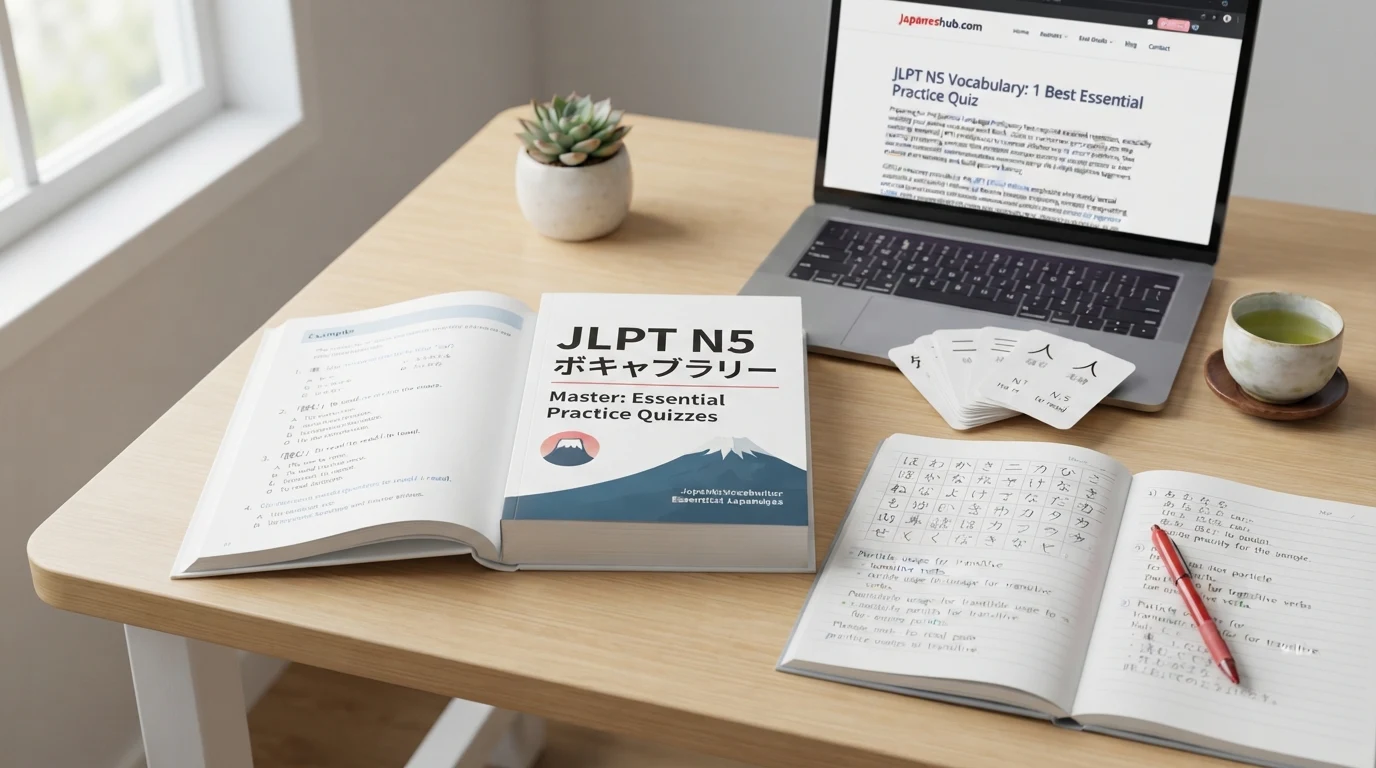
Preparing for the Japanese Language Proficiency Test requires targeted repetition, especially when building your foundational word bank. If you’re starting your preparation journey, mastering essential JLPT N5 vocabulary is the most effective way to secure points on the reading and listening sections. This complete resource delivers structured practice, clear grammatical context, and real-world test questions designed to help absolute beginners evaluate their readiness and build genuine fluency.
Official resources provided by the JLPT Official Website emphasize that steady lexical acquisition is critical for clearing the baseline language knowledge sections. Incorporating practical conversational frameworks modeled after materials from the Irodori Japanese Online Course ensures that the words you memorize apply directly to daily life in Japan rather than existing solely as abstract flashcard entries.
- Core Concepts and Foundations
- Step-by-Step Practical Guide
- Common Mistakes and How to Avoid Them
- Quick Reference Summary Table
- Frequently Asked Questions
- Key Takeaway
Table of Contents
- Core Concepts and Foundations
- Step-by-Step Practical Guide to Mastering JLPT N5 Vocabulary
- Common Mistakes and How to Avoid Them
- Quick Reference Summary Table
- Frequently Asked Questions
- Key Takeaway
Core Concepts and Foundations

The Japanese Language Proficiency Test N5 level evaluates your ability to understand basic Japanese used in everyday situations. To pass this level, you must master roughly 800 core words alongside about 100 essential kanji characters. Building a robust foundation in JLPT N5 vocabulary means more than memorizing isolated English definitions; it requires understanding pitch accent context, kanji readings (both on’yomi and kun’yomi), and exact particle pairing rules.
Also Read:
- Minna no Nihongo Lesson 10: Master Nihongo existence vocabulary (あります vs います)
- Minna no Nihongo Lesson 9 Vocabulary & Potential Verbs
- Minna no Nihongo Lesson 8 Vocabulary: な-adjectives vs. い-adjectives
Examiners test your knowledge across several primary categories: nouns (people, places, food, time), verbs (action and state words), adjectives (i-adjectives and na-adjectives), and particles or expressions. When studying your JLPT N5 vocabulary list, always learn words inside active sentences rather than flashcard isolation. Reference guides such as Tae Kim’s Guide to Learning Japanese illustrate that understanding core sentence structures alongside vocabulary prevents common structural errors during the exam.
Step-by-Step Practical Guide to Mastering JLPT N5 Vocabulary
To test your readiness, this interactive sequence provides authentic practice items mirroring actual exam formats. Work through each sub-section step by step to evaluate your comprehension.
Step 1: Noun and Time Expression Quiz
Nouns make up the largest portion of basic test questions. Let us test your knowledge of daily life objects and temporal nouns.
Question 1: Choose the correct reading for the word “車”.
A) くるま (kuruma)
B) いぬ (inu)
C) ひと (hito)
D) えき (eki)Pedagogical Explanation: 「車」 refers to an automobile or car. Option B means “dog”, Option C means “person”, and Option D means “station”. Knowing single-kanji and compound nouns is essential for the kanji-reading sub-section of the JLPT N5 test.
Question 2: Which option indicates “tomorrow” in Japanese?
A) きのう (kinō – yesterday)
B) きょう (kyō – today)
C) あした (ashita – tomorrow)
D) まいにち (mainichi – every day)Pedagogical Explanation: Temporal nouns frequently appear in reading passages to establish when an action takes place. Distinguishing between past (
きのう), present (きょう), and future (あした) time markers is a fundamental requirement for the N5 syllabus.
Step 2: Verb Conjugation and Action Recognition
Verbs at the N5 level split into Godan (u-verbs) and Ichidan (ru-verbs). Recognizing their dictionary and polite forms is vital for vocabulary sections.
Question 3: Select the correct meaning for the Godan verb 「読む」 (yomu).
A) To drink
B) To read
C) To write
D) To listenPedagogical Explanation: 「読む」 (yomu) is a standard Godan verb. Option A is 「飲む」 (nomu – to drink), Option C is 「書く」 (kaku – to write), and Option D is 「聞く」 (kiku – to listen). Mastering high-frequency action verbs ensures you can answer direct meaning questions quickly.
Question 4: What is the polite non-past form of the Ichidan verb 「食べる」 (taberu)?
A) 食べます (tabemasu)
B) 食べました (tabemashita)
C) 食べて (tabete)
D) 食べません (tabemasen)Pedagogical Explanation: Ichidan verbs form their polite non-past affirmative by dropping the final る (ru) and adding ます (masu). Option B is the past affirmative, Option C is the te-form, and Option D is the polite non-past negative.
Step 3: Adjective Modification Context
Adjectives split into i-adjectives (ending directly in い) and na-adjectives (requiring な before nouns).
Question 5: Which option correctly completes the sentence: 「これは____本です。」 (This is an interesting book.)
A) おおきい (ookii – big)
B) おもしろい (omoshiroi – interesting)
C) たかい (takai – expensive/tall)
D) あつい (atsui – hot)Pedagogical Explanation: Books can be big or expensive, but when describing a narrative or reading material as engaging, 「おもしろい」 (omoshiroi) is the correct adjective. It connects directly to the noun without any particle.
Question 6: Choose the correct na-adjective to complete the phrase: 「____な部屋」 (A quiet room)
A) じょうず (jōzu – skillful)
B) しずか (shizuka – quiet)
C) げんき (genki – healthy/energetic)
D) すき (suki – liked)Pedagogical Explanation: Na-adjectives require the particle な when modifying a noun directly. 「しずか」 (shizuka) correctly pairs with 「部屋」 (heya – room) to mean a quiet room.
Step 4: Example Sentence Context Analysis
Reviewing how terms function inside full sentences bridges the gap between passive memorization and active exam success.
| Kanji & Kana | Romaji | English Meaning | Example Sentence |
|---|---|---|---|
| 学校 (がっこう) | gakkō | School | 毎日学校へ行きます。(Mainichi gakkō e ikimasu.) |
| 食べる (たべる) | taberu | To eat | りんごを食べます。(Ringo o tabemasu.) |
| 静か (しずか) | shizuka | Quiet (na-adj) | この部屋は静かです。(Kono heya wa shizuka desu.) |
| 先生 (せんせい) | sensei | Teacher | 先生に質問します。(Sensei ni shitsumon shimasu.) |
| 買う (かう) | kau | To buy (Godan verb) | 新しい靴を買います。(Atarashii kutsu o kaimasu.) |
Common Mistakes and How to Avoid Them
Beginners often stumble over specific lexical traps during test preparation. Recognizing these errors early will drastically improve your scoring accuracy.
- Confusing Similar Kana Characters: Learners frequently mix up
め(me) andぬ(nu), orわ(wa) andね(ne). Always write out your vocabulary words by hand to build muscle memory for distinct stroke curves. - Ignoring Transitive and Intransitive Pairs: While N5 features fewer complex pairs than upper levels, confusing words like
あく(aku – intransitive, to open) andあける(akeru – transitive, to open something) lead to particle errors. Always learn verbs with their standard particles (e.g.,ドアが開くvs.ドアを開ける). - Neglecting Pronunciation Long Vowels: Failing to distinguish between short vowels and long vowels (e.g.,
おばさん/ obasan – aunt vs.おばあさん/ obāsan – grandmother) results in listening and vocabulary comprehension failures. - Misapplying Adjective Connectors: Attaching
なto i-adjectives (e.g., writingたかいな本instead ofたかい本) is a classic mistake. Remember that i-adjectives connect directly to nouns without any intervening particle.
Quick Reference Summary Table
This table summarizes essential high-frequency terms categorized by word class for rapid daily revision.
| Category | Japanese (Kanji & Kana) | Hepburn Romaji | English Meaning |
|---|---|---|---|
| Noun | 時間 / じかん | jikan | Time |
| Noun | 友達 / ともだち | tomodachi | Friend |
| Verb | 飲む / のむ | nomu | To drink |
| Verb | 行く / いく | iku | To go |
| I-Adjective | 新しい / あたらしい | atarashii | New |
| Na-Adjective | 元気 / げんき | genki | Healthy / Energetic |
| Adverb | いつも | itsumo | Always |
| Particle | から | kara | From / Because |
| Expression | ありがとう | arigatō | Thank you |
Frequently Asked Questions
To pass the JLPT N5 level, you need to master roughly 800 core vocabulary words and about 100 essential kanji characters. Building this lexical foundation allows you to understand basic daily phrases and simple sentences. Pairing your word lists with practical sentence structures ensures you can apply these terms accurately in both reading and listening test sections.
No, the Japan Foundation and JEES stopped publishing official vocabulary and kanji lists after the 2010 test revision. However, modern study lists are accurately compiled from pre-2010 Level 4 specifications and past exam papers, covering the exact 700 to 800 high-frequency words tested today.
Most beginners need around 150 to 250 total study hours to prepare for the JLPT N5. If you learn and review 10 new words a day using spaced repetition flashcards, you can comfortably master the entire 800-word vocabulary list in about 3 months.
The most effective way to eliminate confusion between similar kana like ぬ (nu) and め (me) is active handwriting practice. Write out your vocabulary lists daily while paying close attention to stroke endings and looping curves. You can also explore supplementary reference tools like Tae Kim’s Guide to Learning Japanese to reinforce foundational script recognition.
Yes, mastering both Hiragana and Katakana is mandatory before diving into N5 vocabulary. The official JLPT exam does not use Romaji (English letters), and Katakana is heavily tested for loanwords, food items, and everyday objects.
Transitive verbs require a direct object marked with を (o) to show an action performed on something, such as ドアを開ける (to open a door). Intransitive verbs describe a state or occurrence without a direct object, taking particles like が (ga), as seen in ドアが開く (the door opens). Learning these verb pairs alongside their natural particle pairings prevents common grammatical errors on the test.
I-adjectives end in the mora い and modify nouns directly without any connector, such as たかい本 (an expensive book). Na-adjectives require the particle な when placed directly before a noun, such as しずかな部屋 (a quiet room). Mastering these distinct modification rules is critical for scoring well on the language knowledge sections.
No, the 800-word benchmark counts dictionary headwords rather than individual inflections. For example, 食べる (to eat) counts as a single vocabulary word even though you must recognize its polite form (食べます), negative form (食べません), and past tense (食べました) on the exam.
Improving your listening score requires consistent exposure to native audio materials that match test speeds and conversational patterns. Focus on distinguishing critical vowel lengths, such as the difference between おばさん (aunt) and おばあさん (grandmother). Regular dictation practice and shadowing exercises will drastically sharpen your auditory accuracy.
The Vocabulary section (Language Knowledge) is the first part of the exam and lasts 20 minutes. It tests Kanji reading, Hiragana-to-Katakana/Kanji orthography, context-defined expressions, and paraphrases. To pass the overall N5 exam, you need at least 80 out of 180 total points, including a minimum sectional score of 38/120 in Language Knowledge and Reading.
Genki I and Minna no Nihongo Beginner I are the two gold-standard textbooks for building N5 vocabulary in grammatical context. Pairing either textbook with a Spaced Repetition System (SRS) app like Anki or WaniKani helps lock words into your long-term memory.
Yes, thousands of learners pass the JLPT N5 through self-study every year. Because the exam is 100% multiple-choice and does not test speaking or essay writing, consistent daily practice with beginner textbooks, audio drills, and timed mock quizzes is enough to pass.
Key Takeaway
Mastering foundational JLPT N5 vocabulary is the single most important step for absolute beginners aiming to pass the Japanese Language Proficiency Test. By combining systematic kanji memorization, precise kana handwriting, and correct particle pairings, you bridge the gap between passive recognition and active exam success. Consistent daily repetition transforms abstract flashcard items into practical communication tools for real-world scenarios.
- Build a steady study habit by reviewing 15 to 20 core vocabulary terms every single day.
- Practice writing all new words by hand to permanently fix similar kana characters and kanji stroke orders in your memory.
- Memorize every verb and adjective alongside its proper particle and grammatical modifier to avoid common test traps.
- Test your knowledge regularly with timed practice quizzes to evaluate your readiness for the official exam environment.
Conclusion
Building your JLPT N5 vocabulary is the foundation that turns early Japanese study into real reading, listening, and exam confidence. Mastering roughly 800 core words, 100 essential kanji, kana distinctions like ぬ and め, verb transitivity pairs, and adjective modification rules gives you the exact building blocks needed to navigate everyday Japanese and clear the N5 exam.
Rather than chasing massive word counts in isolation, focus on consistent daily review, active handwriting, and seeing how each word behaves inside real sentences and audio. Pair your practice quizzes with structured study habits, and you will build steady momentum toward passing JLPT N5—and stepping into N4 with confidence.