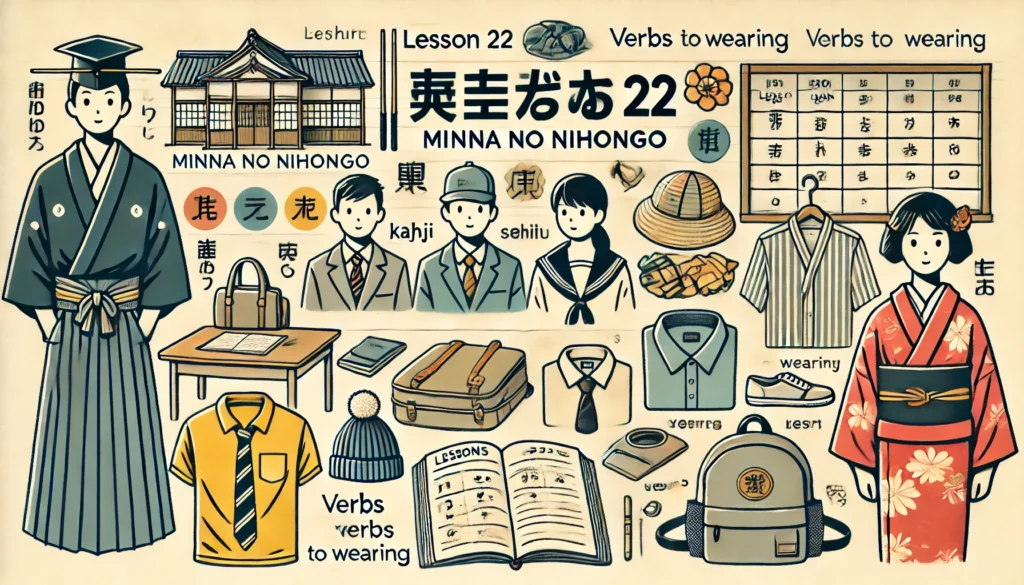
Mastering Minna No Nihongo Lesson 22 Vocabulary: Minna no Nihongo is a widely celebrated resource for learning Japanese, especially for beginners aiming to build a solid foundation. Lesson 22 introduces learners to key vocabulary and sentence patterns that enhance their conversational abilities. This article will break down the vocabulary from Lesson 22 into digestible chunks, providing meanings and usage tips to make learning enjoyable and practical.
Read More: Minna no Nihongo N5 Listening
Minna No Nihongo Lesson 22 Vocabulary Practice
Below is a table highlighting essential words and phrases from Minna no Nihongo Lesson 22:
| Japanese (Kanji/Kana) | Romaji | English Meaning |
|---|---|---|
| 着ます (着る) | kimasu / kiru | To wear (upper body) |
| ふとんど | futon do | Almost; mostly |
| かけます (かける) | kakemasu / kakeru | To hang (something) |
| 持ちます (持つ) | mochimasu / motsu | To hold; to carry |
| ですが | desu ga | However; but |
| つきます (つく) | tsukimasu / tsuku | To arrive |
| はきます (はく) | hakimasu / haku | To wear (lower body) |
| かぶります (かぶる) | kaburimasu / kaburu | To wear (on head) |
| します | shimasu | To wear (accessories) |
| 生まれます (生まれる) | umaremasu / umareru | To be born |
| 知ります (知る) | shirimasu / shiru | To know |
| 習います (習う) | naraimasu / narau | To learn |
| 覚えます (覚える) | oboemasu / oboeru | To remember |
| 忘れます (忘れる) | wasuremasu / wasureru | To forget |
| 探します (探す) | sagashimasu / sagasu | To search |
| 座ります (座る) | suwarimasu / suwaru | To sit |
| 立ちます (立つ) | tachimasu / tatsu | To stand |
| 入ります (入る) | hairimasu / hairu | To enter |
| 出ます (出る) | demasu / deru | To leave |
| 起きます (起きる) | okimasu / okiru | To wake up |
| 寝ます (寝る) | nemasu / neru | To sleep |
| 働きます (働く) | hatarakimasu / hataraku | To work |
| 休みます (休む) | yasumimasu / yasumu | To rest |
| 使います (使う) | tsukaimasu / tsukau | To use |
| 作ります (作る) | tsukurimasu / tsukuru | To make |
| 売ります (売る) | urimasu / uru | To sell |
| 買います (買う) | kaimasu / kau | To buy |
| 飲みます (飲む) | nomimasu / nomu | To drink |
| 読みます (読む) | yomimasu / yomu | To read |
| 書きます (書く) | kakimasu / kaku | To write |
Common Sentence Patterns in Lesson 22
1. Expressing “to wear” using 着ます (kimasu):
- Example: しゃつを着ます。 (Shatsu o kimasu.)
- Meaning: I wear a shirt.
2. Using “but” with ですが (desu ga):
- Example: ほんをよみますが、おもしろくないです。 (Hon o yomimasu ga, omoshiroku nai desu.)
- Meaning: I read the book, but it’s not interesting.
3. Expressing arrival with つきます (tsukimasu):
- Example: 銀行につきます。 (Ginkō ni tsukimasu.)
- Meaning: I arrive at the bank.
Practical Tips for Learning Vocabulary
- Use Flashcards: Write the Japanese word on one side and the English/Nepali meaning on the other.
- Practice in Context: Create sentences using the new words to understand their usage better.
- Engage in Conversations: Pair with a language partner to practice speaking and listening.
FAQs about Minna no Nihongo Lesson 22
What is the main focus of Lesson 22 in Minna no Nihongo?
Lesson 22 emphasizes clothing-related vocabulary, basic conjunctions like “but,” and expressions about arrival and holding items.
How can I remember the vocabulary effectively?
Using spaced repetition systems (SRS) and writing down example sentences will reinforce memory.
Is Lesson 22 suitable for absolute beginners?
Yes, it builds on foundational grammar and vocabulary, making it accessible for new learners.
Conclusion
Lesson 22 of Minna no Nihongo is an exciting step forward in mastering the Japanese language. By focusing on practical vocabulary and sentence patterns, learners can enhance their ability to describe daily activities and engage in basic conversations. Make the most of the tips and examples shared here to maximize your learning.