
Are you struggling to express yourself in everyday situations with Nihongo? Do you find yourself relying on translation apps or struggling to understand the nuances of the language? You’re not alone. Many learners of Japanese face this challenge, and it’s essential to overcome it to truly communicate with native speakers.
Minna no Nihongo, a popular Japanese language learning platform, offers a comprehensive approach to learning the language. One of its key features is the vocabulary section, which provides learners with a vast array of words and phrases to improve their communication skills. In this article, we’ll focus on Lesson 9 of the Minna no Nihongo vocabulary section, exploring the new words and phrases that will help you sound more natural and confident in your Nihongo. We’ll also delve into the potential verbs associated with these words, providing you with a deeper understanding of how to use them in context. By the end of this article, you’ll be better equipped to tackle everyday conversations and connect with native speakers.
Also Read:
Minna no Nihongo Lesson 9 Overview
Welcome to Minna no Nihongo Lesson 9, where we will explore the world of Nihongo vocabulary and potential verbs. In this lesson, we will focus on learning new words and phrases that can help you communicate effectively in everyday situations.
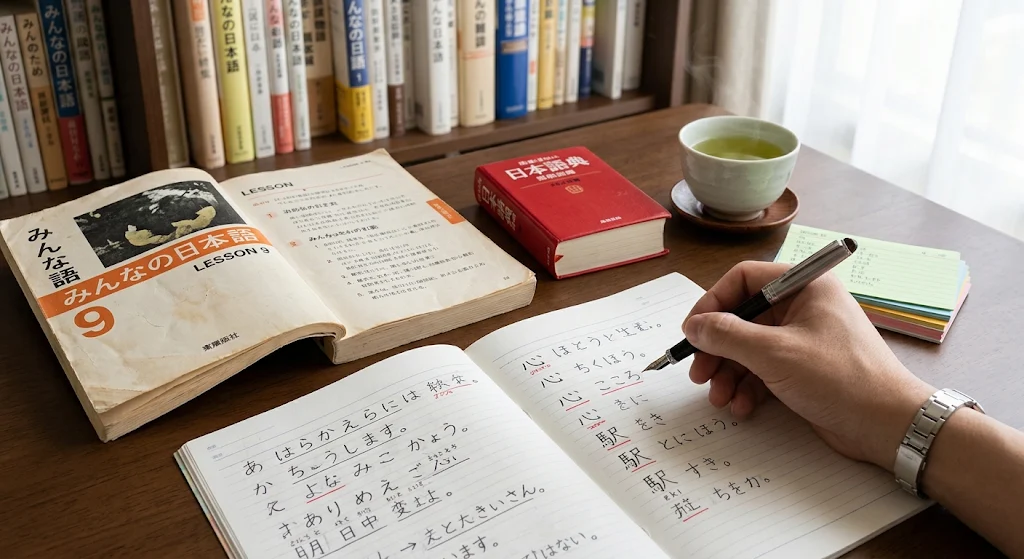
New Vocabulary
In this lesson, we will learn 10 new vocabulary words that are essential for communication in various contexts. These words include:
- Kokoro こころ(心): meaning “heart” or “mind”
- Yume ゆめ(夢): meaning “dream”
- Sakura さくら(桜): a type of flower
- Kawa かわ(川): meaning “river”
- Tora とら(虎): meaning “tiger”
- Sai (さい): meaning “season” or “time”
- Kossetsu こっせつ (骨折): meaning “broken bone”
- Kaze かぜ (風): meaning “wind”
- Tegami てがみ(手紙): meaning “letter”
- Hana はな(花): meaning “flower”
Potential Verbs
We will also learn 5 new potential verbs that can be used in various contexts. These verbs include:
- Kuru くる(来る): meaning “to come”
- Aru (ある): meaning “to be”
- Iru (いる): meaning “to be”
- Suru (する): meaning “to do”
- Eki えき (駅): meaning “station” (Note: Eki is a potential verb in Japanese, but it’s not commonly used as a verb in everyday language)
Practice Time
To practice what you’ve learned, try using the new vocabulary words and potential verbs in your own sentences. You can also try speaking with a language partner or recording yourself to practice your pronunciation.
Remember, learning Nihongo vocabulary and potential verbs takes time and practice. Be patient and persistent, and you will see improvement over time.
Vocabulary for Minna no Nihongo Lesson 9
In this lesson of Minna no Nihongo, you will learn new vocabulary and practice using potential verbs to express yourself in everyday situations. Here are some essential words and phrases to help you improve your Japanese language skills:
Food and Drink
– O-cha (green tea) – a popular beverage in Japan
– Ramen (ラメン)(noodle soup) – a popular Japanese dish
– Yakitori(やきとり) (grilled chicken skewers) – a popular Japanese street food
– Miso みそ(soybean paste) – a common ingredient in Japanese cooking
– Sushi すし(vinegared rice with raw fish) – a popular Japanese dish
Shopping
– Kanji (かんじ)(characters) – used to write Japanese words
– Toro (とろ)(fatty tuna) – a popular ingredient in sushi
– Tsumugi (つむぎ)( silk) – a high-quality fabric
– Sakuga (さくが)(high-quality) – used to describe goods
– Kannzenn (かんぜん)(perfect) – used to describe the quality of goods
Travel
– Hikou(ひこう) (travel) – to go on a journey
– Kokoro (こころ)(heart) – used to describe the feelings of a place
– Sakura (さくら)(cherry blossom) – a famous Japanese spring symbol
– Yurei (ゆれい)(ghost) – a popular Japanese folklore creature
– Mizu (みず)(water) – a common element in Japanese landscapes
Daily Life
– Ganbatte (try hard) – an expression used to encourage oneself
– Yorokobu (happy) – an expression used to describe a feeling
– Sakazuki ( sake) – a traditional Japanese beverage
– Tanoshimu (たのしむ)(fun) – an expression used to describe an enjoyable experience
– Gomen (ごめん)(sorry) – a common expression used to apologize
These words and phrases will help you to communicate effectively in everyday situations in Japan. Remember to practice using them in context to improve your Japanese language skills.
Potential Verbs for Minna no Nihongo Lesson 9
In this lesson, we’ll focus on three potential verbs that are essential for everyday conversations in Japanese. These verbs are:
- iru (いる)(to exist, to be in a place)
- taberu (たべる)(to eat)
- miru (みる)(to see)
Iru (to exist, to be in a place)
“Iru” is a versatile verb that can be used to describe various situations, such as living in a place, working, or studying. Here are a few examples:
- “Watashi wa Tokyo ni iru.” (I live in Tokyo.)
- “Anata wa Tokyo ni iru ka?” (Are you living in Tokyo?)
Taberu (to eat)
“Taberu” is a common verb used to describe eating habits and food preferences. Here are a few examples:
- “Watashi wa sushi o taberu.” (I like eating sushi.)
- “Anata wa ramen o taberu ka?” (Do you like eating ramen?)
Miru (to see)
“Miru” is a verb used to describe visual experiences, such as looking at something or someone. Here are a few examples:
- “Watashi wa kawaii o miru.” (I see something cute.)
- “Anata wa anime o miru?” (Do you watch anime?)
These potential verbs are essential for everyday conversations in Japanese. By mastering these verbs, you’ll be able to express yourself more effectively and engage in meaningful interactions with native speakers.
Using Nihongo Vocabulary in Context
Now that you have learned the new vocabulary in Lesson 9, it’s time to put it into practice. Using Nihongo vocabulary in context is essential to improve your language skills and build your confidence in communicating with native speakers.
Let’s take the word “tabemono” (food) as an example. You can use it in a sentence like this: “Watashi wa tabemono o kuu ni suki desu” (I like eating food). Notice how the vocabulary is used in a simple sentence to convey a meaning. You can also use it in more complex sentences, such as: “Watashi wa tabemono o kuu ni suki desu, toshite wa kono ryokou ni ikimasu” (I like eating food, so I’ll go on that trip).
Another example is the word “gakusei” (student). You can use it in a sentence like this: “Watashi wa gakusei desu” (I am a student). You can also use it in a sentence like: “Watashi wa gakusei desu, kono gakko ni imasu” (I am a student, and I attend this school).
To use Nihongo vocabulary in context, try to think of situations where you can use the words you have learned. For example, if you’re going to a restaurant, you can use the word “tabemono” to order food. If you’re at school, you can use the word “gakusei” to introduce yourself to your classmates.
Remember, using Nihongo vocabulary in context is not just about memorizing words, but also about understanding how to use them correctly in different situations. With practice, you’ll become more confident in using Nihongo vocabulary in your daily life.
Tips for Learning Nihongo Potential Verbs
As you progress in learning Nihongo, you’ll come across potential verbs that can add variety to your sentences and express different shades of meaning. Potential verbs, also known as “joshi verbs” in Japanese, are verbs that can be used in place of other verbs to convey different meanings or intensities. Here are some tips to help you learn and use potential verbs effectively:
1. Understand the different forms of potential verbs
Potential verbs come in different forms, including the base form, the potential form, and the actual form. The base form is the verb stem, while the potential form is the verb stem with a suffix (-ta, -te, -te iru, or -te kudasai) that indicates potentiality. The actual form is the verb stem with the main verb ending (-u, -i, -masu, or -masen).
2. Learn the most common potential verbs
Some common potential verbs include:
- taberu (to eat) -> tabeta (I ate)
- mita (to see) -> mita (I saw)
- kaku (to write) -> kakatta (I wrote)
- tsukamu (to hold) -> tsukatta (I held)
3. Practice using potential verbs in context
Try replacing other verbs with potential verbs in your sentences to see the difference in meaning. For example:
- “I saw the movie” (mita) instead of “I see the movie” (mita)
- “I ate breakfast” (tabeta) instead of “I ate” (taberu)
4. Use potential verbs to express different meanings
Potential verbs can be used to express different meanings or intensities, such as:
- taberu (to eat) vs. tukuru (to pick up)
- mita (to see) vs. mi (to look)
By learning and using potential verbs effectively, you can add more variety and nuance to your Nihongo language skills. Remember to practice regularly and use potential verbs in context to improve your proficiency.
Common Mistakes to Avoid in Minna no Nihongo
As learners of Minna no Nihongo, it’s essential to be aware of common mistakes that can make it difficult for you to communicate effectively in Japanese. Here are some common errors to watch out for:
Incorrect Use of Honorifics
In Japanese, honorifics are used to show respect to others, particularly those of higher social status or age. However, many learners misuse honorifics, using them incorrectly or inconsistently.
For example, the polite form of “to eat” is *taberu* (taberu), not *tabemasu* (tabemasu). Using the polite form in informal situations can come across as insincere or even rude.
Another mistake is to use the honorific *o* (o) in place of the polite suffix *-masu* (masu) in sentences. For example, *Anata wa hon o yonda ka* (Anata wa hon o yonda ka) is incorrect; instead, use *Anata wa hon o yonda no desu ka* (Anata wa hon o yonda no desu ka).
Misusing *Desu* and *Da*
In Minna no Nihongo, the present tense is often formed using the verb *desu* (desu) or *da* (da), depending on the subject and context.
However, many learners incorrectly use *desu* in situations where *da* is more suitable. For example, *Watashi wa gakusei desu* (Watashi wa gakusei desu) is incorrect; instead, use *Watashi wa gakusei da* (Watashi wa gakusei da).
*Desu* is typically used to describe a general truth or fact, whereas *da* is used to describe a temporary state or condition.
Using the Wrong Tense
Minna no Nihongo also requires learners to use the correct tense to convey meaning accurately. For example, the past tense of *taberu* (to eat) is *tabe-tta* (tabe-tta), not *tabe-ta* (tabe-ta).
By avoiding these common mistakes, you can improve your communication skills and sound more natural in Japanese.
Conclusion: Next Steps in Nihongo Learning
Congratulations on completing Lesson 9 of Minna no Nihongo! You’ve now learned a significant amount of new vocabulary and practiced using potential verbs in context. As you move forward in your Nihongo learning journey, here are some practical next steps to help you reinforce your new skills:
Review and Practice
- Review the new vocabulary words daily, using flashcards or apps like Anki to help you memorize their meanings and pronunciations.
- Practice using the new vocabulary in sentences, either on your own or with a language exchange partner.
Focus on Grammar and Sentence Structure
- Spend some time reviewing the grammar concepts covered in Lesson 9, such as the use of potential verbs in different sentence structures.
- Practice constructing sentences using the new vocabulary and grammar concepts, focusing on accuracy and clarity.
Engage with Native Speakers
- Watch Japanese TV shows or movies with English subtitles to improve your listening skills and get exposure to natural language use.
- Try to find language exchange partners or tutors who can help you practice your speaking and listening skills.
Immerse Yourself in the Language
- Listen to Japanese music, podcasts, or radio shows to get used to the sounds and rhythms of the language.
- Try cooking Japanese recipes or watching Japanese cooking videos to learn new vocabulary and get a feel for the culture.
Set Realistic Goals and Track Progress
- Set achievable goals for your Nihongo learning, such as mastering a certain number of vocabulary words or holding a 10-minute conversation with a native speaker.
- Track your progress regularly, using a journal or spreadsheet to monitor your progress and stay motivated.
By following these next steps, you’ll be well on your way to becoming more confident and proficient in Nihongo. Remember to stay consistent, persistent, and patient, and don’t be afraid to make mistakes along the way. Good luck!
Frequently Asked Questions
Use ga dekimasu when attaching to nouns or noun-ized verb stems (e.g., nihongo ga dekimasu – “I can speak Japanese”). Use the direct potential verb form when turning a specific standalone action verb into “can do [that action].”
Japanese grammar treats objects of desire, capability, or comprehension (like wakarimasu, suki desu, and dekimasu) as entities that exist relative to the speaker. Therefore, the particle ga marks the target of that ability or feeling rather than a direct object receiving an action.
Use wa (は) to establish the general topic of the sentence (e.g., Watashi wa — “As for me…”). Use ga (が) to highlight the specific skill or object being focused on, such as kanji ga dekimasu (“As for me, kanji [ability] is possible”).
Yes! All potential verbs in Japanese conjugate according to Group 2 (-eru / -iru ending) rules, regardless of whether their dictionary-form original verb belongs to Group 1 (u-verbs) or Group 2.
You can change the ending to the negative polite form: ~dekimasen for nouns + *ga dekimasu*, or conjugate the potential verb into its negative form (e.g., *taberaremasen* – “cannot eat”).
While arimasu expresses the existence of inanimate objects or possession of concrete items (like time or money), capabilities and learned skills are expressed using dekimasu.
Usually, the particle ga (が) replaces the direct object particle o (を) when using potential verbs or expressions of ability (e.g., sushi ga taberareru).
No, wakarimasu is an intransitive verb meaning “to understand,” but it grammatically behaves similarly in Lesson 9 because it takes the particle ga instead of o.
Take standard Group 1 and Group 2 verbs you already know from previous lessons (like *kaku*, *nomu*, *yomu*) and practice converting them into their potential forms (*kakeru*, *nomeru*, *yomeru*), then build simple sentences around them.
In conversational Japanese, you will occasionally hear native speakers use o instead of ga with potential verbs due to overlapping historical grammar patterns, but standard Minna no Nihongo tests and formal Japanese strictly require ga.
Yes! Dekimasu can also mean “to be completed,” “to be finished,” or “to be ready” depending on the context of the sentence (e.g., when food or a project is finished).
Explore the rest of the Japaneshub resources and vocabulary guides tailored for N5 and N4 learners to keep mastering your grammar step-by-step!
Conclusion
In this 9th lesson of Minna no Nihongo, we’ve covered the importance of vocabulary and potential verbs in enhancing our Japanese language skills. By learning and practicing the words and phrases presented in this lesson, you’ll be able to communicate more effectively and confidently in everyday situations.
To further improve your Nihongo vocabulary and grammar, we recommend that you practice using the new words and phrases in context. Try to find native speakers or language exchange partners to practice your conversation skills, and don’t be afraid to make mistakes. With consistent practice, you’ll become more proficient in Japanese and be able to navigate everyday situations with ease.
Next, we suggest exploring online resources, such as language learning apps or YouTube channels, that provide additional vocabulary and grammar lessons, as well as opportunities to practice with native speakers. By taking the next step in your Japanese language journey, you’ll continue to see progress and improvement in your skills.